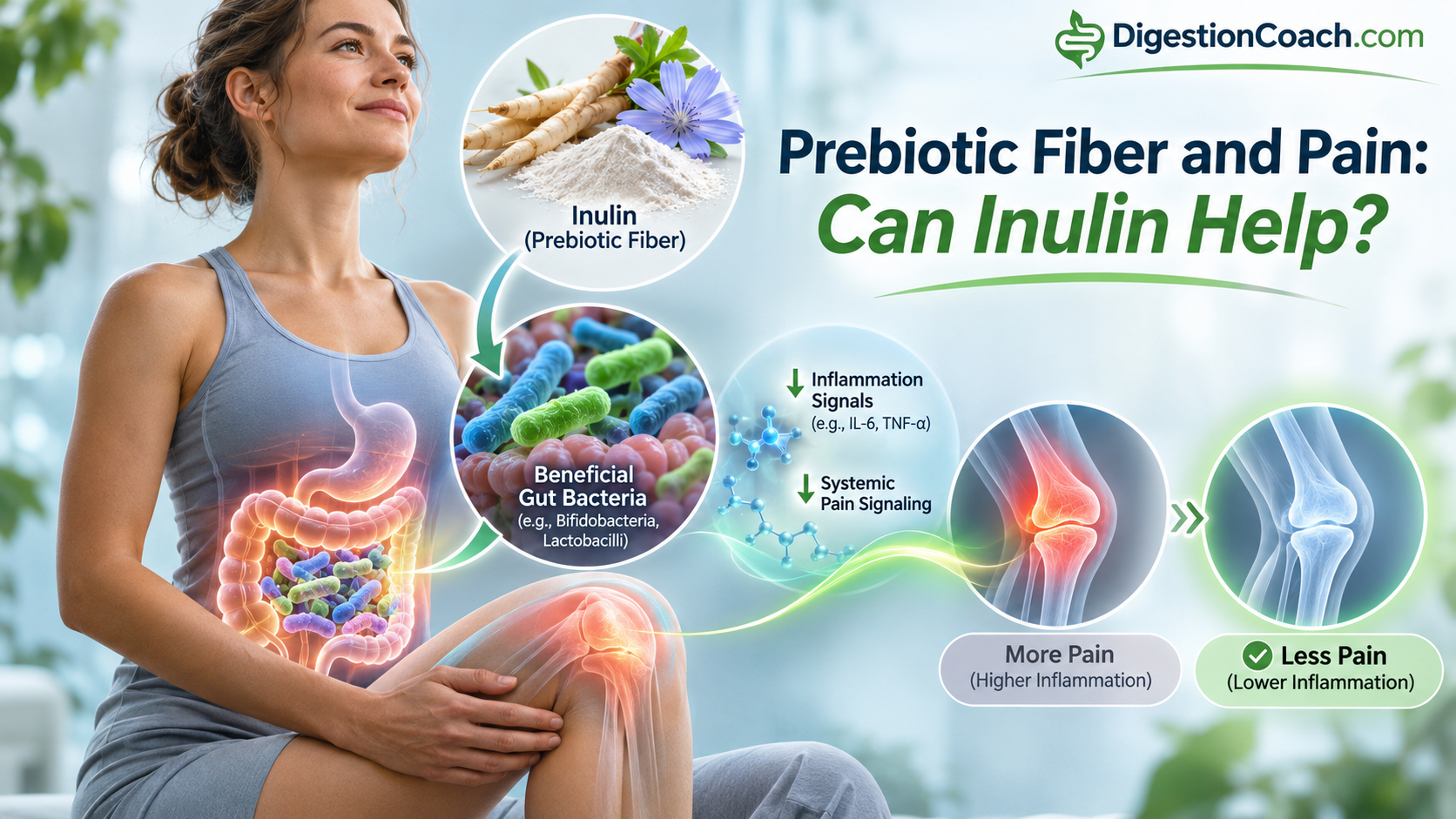
Prebiotic Fiber and Pain: Can Feeding Gut Bacteria Reduce Pain?
By Marcus Ettinger, D.C. | The Digestion Coach
What is the connection between prebiotic fiber and pain? Most people associate fiber with bowel movements, constipation, and digestive health. However, researchers are discovering that certain fibers may also influence how the body responds to pain. A 2026 clinical trial offers an interesting example: people who took inulin, a prebiotic fiber, experienced improvements in knee pain and some measures of pain sensitivity.
This finding raises an important question. Could feeding certain gut bacteria influence how the nervous system processes pain outside the digestive tract?
The answer may be yes, but the science is still developing.
Researchers also found changes in two biological signals: butyrate, a substance associated with microbial fermentation, and glucagon-like peptide-1 (GLP-1), a hormone produced by cells in the intestine.
Yet the study revealed an equally important finding. Nearly half of the participants who completed inulin treatment experienced digestive side effects, mainly gas and bloating.
For anyone with IBS, SIBO, intestinal methanogen overgrowth (IMO), or food sensitivities, this matters.
A fiber can offer potential benefits outside the gut while still causing discomfort inside the gut.
Let’s examine what the researchers discovered, what remains uncertain, and why individual digestive tolerance matters as much as a supplement’s potential benefits.
What Did the Prebiotic Fiber and Pain Study Investigate?
Researchers at the University of Nottingham conducted a randomized clinical trial called INSPIRE. They wanted to learn whether inulin supplementation could help people with knee osteoarthritis.
Osteoarthritis affects joints and can cause pain, stiffness, and reduced physical function. However, joint changes alone do not fully explain why some people experience more pain than others.
The nervous system also influences how strongly the body detects and responds to painful signals.
Researchers wanted to know whether an intervention targeting gut-related biology could affect this process.
They randomized 136 adults with knee osteoarthritis into four treatment groups:
- Inulin: 20 grams of prebiotic fiber daily.
- Physiotherapy: A structured exercise program delivered through a digital platform.
- Combined treatment: Inulin plus physiotherapy.
- Comparison: Maltodextrin, a carbohydrate supplement, alongside usual self-management.
Of the 136 randomized participants, 117 completed the six-week assessment.
The researchers measured knee pain, physical performance, grip strength, and responses to controlled painful stimulation. They also measured circulating short-chain fatty acids and GLP-1.
These additional measurements made the study particularly interesting. The investigators could look beyond pain scores and explore changes in how participants responded to painful stimuli.
Did Prebiotic Fiber Reduce Knee Pain?
Yes. The trial found that inulin supplementation improved knee pain compared with the comparison group.
After six weeks, the researchers reported a 1.11-point greater reduction in knee pain on a 0–10 rating scale after adjusting for baseline pain.
The result reached statistical significance, with a p-value of 0.045.
Physiotherapy also reduced pain. Its adjusted difference compared with the comparison group was approximately 1.55 points.
These numbers represent average differences between treatment groups. They do not mean every participant improved by exactly that amount.
The researchers did not demonstrate an additional synergistic benefit from combining inulin and physiotherapy. However, the study had limited statistical power to detect such an interaction.
This is an important distinction.
The trial offers evidence that inulin may help reduce pain in some people with knee osteoarthritis. It does not establish that inulin treats arthritis generally or should replace standard care.
Still, the prebiotic fiber and pain connection becomes more interesting when we examine the tests of pain sensitivity.
How Prebiotic Fiber May Affect Pain Sensitivity
Pain is not simply a direct measurement of tissue damage.
Your nervous system receives information from tissues, interprets that information, and influences how intensely you experience it.
Two people with similar joint changes can have very different pain levels.
Researchers therefore examined whether inulin changed participants’ responses to controlled painful stimulation.
Pressure-Pain Threshold: When Does Pressure Begin to Hurt?
A pressure-pain threshold test measures how much pressure someone tolerates before the sensation becomes painful.
A higher threshold generally means the person can tolerate more pressure before reporting pain.
In the trial, participants receiving inulin showed favorable changes in selected pressure-pain measurements.
This suggests that the intervention may have influenced how participants responded to mechanical pain.
Temporal Summation: When Repeated Pain Feels Stronger
Temporal summation describes what happens when repeated painful stimulation begins to feel increasingly intense.
For example, the first stimulus may feel mildly uncomfortable. When the same stimulus occurs repeatedly, the person may experience progressively greater pain even though its intensity has not increased.
This response can provide information about pain amplification within the nervous system.
The study found that more participants receiving inulin experienced improvements in temporal summation than those in the comparison group.
These findings make the relationship between prebiotic fiber and pain particularly interesting because the researchers measured changes in pain processing, not just self-reported knee discomfort.
However, we should not take the findings too far.
The trial did not prove that inulin reversed central sensitization, repaired nerves, or corrected a specific neurological disorder.
It showed improvements in experimental measurements associated with pain sensitivity.
Why Would Gut Bacteria Influence Pain Outside the Intestine?
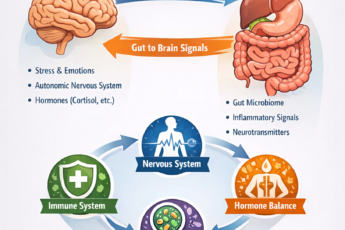
The digestive tract communicates with the rest of the body through several pathways.
These include:
- Signals from the immune system.
- Communication between the gut and nervous system.
- Hormones released by intestinal cells.
- Substances produced during microbial fermentation.
- Metabolic signals carried through the bloodstream.
Together, these pathways help explain why digestive biology may influence functions outside the gastrointestinal tract.
Scientists often refer to parts of this communication network as the gut–brain axis.
But the gut–brain axis does not mean every neurological symptom begins in the intestine.
It means the gut and nervous system exchange biological information, and changes in one system may influence the other.
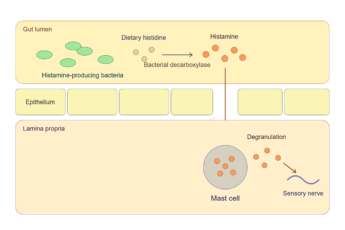
For a related example, see my article Gut Bacteria and IBS Pain: Could Histamine Be the Missing Link?. That research explores a different possible pathway involving microbial histamine, immune cells, and intestinal pain sensitivity.
The inulin trial studied knee pain rather than intestinal pain. Nevertheless, both research areas highlight the importance of communication between microbes, immune pathways, and sensory nerves.
Butyrate: Could Gut Fermentation Help Explain the Pain Results?
Inulin is a type of fermentable fiber called a fructan.
Human digestive enzymes cannot fully break it down in the small intestine. Instead, much of it reaches the colon, where certain microorganisms can ferment it.
During fermentation, microbes produce several substances called short-chain fatty acids.
The major examples include:
- Acetate.
- Propionate.
- Butyrate.
Butyrate is especially important in digestive physiology.
Cells lining the colon can use it as an energy source. It also participates in cellular signaling pathways that influence intestinal and immune function.
Because of these effects, researchers are studying whether changes in butyrate availability might influence functions outside the gut.
What Did the Study Actually Find About Butyrate?
The investigators measured higher circulating butyrate levels in participants receiving inulin.
That finding fits with what we know about microbial fermentation.
However, the researchers did not find a clear association between changes in serum butyrate and improvements in pain or physical function.
This limits what we can conclude.
A possible pathway might look like this:
Inulin intake → microbial fermentation → altered biological signals → possible changes in pain responses.
But the study did not establish that complete chain.
We cannot conclude that increased butyrate caused the pain improvement.
We also cannot assume that a higher blood butyrate level means the intestines produced more butyrate overall.
Blood concentrations reflect several processes, including production, absorption, distribution, and utilization.
For more on why measured microbial metabolites do not always reveal what is happening inside the intestine, see How Gut Transit Time Changes Your Microbiome.
This is one reason I prefer to interpret microbiome research by examining biological function rather than treating any single metabolite as a universal marker of gut health.
Prebiotic Fiber, GLP-1, and the Gut–Muscle Connection
The trial identified another interesting finding involving GLP-1.
GLP-1 stands for glucagon-like peptide-1. Specialized cells in the intestine release this hormone in response to nutritional and metabolic signals.
GLP-1 helps regulate insulin secretion, blood glucose, appetite, and other physiological functions.
Most people recognize the name because certain medications mimic GLP-1 activity.
However, your body naturally produces this hormone.
What Happened to GLP-1 in the Inulin Group?
The researchers measured higher circulating GLP-1 levels following inulin supplementation.
They also found an association between higher GLP-1 and improved grip strength.
Inulin itself produced an adjusted improvement in grip strength of approximately 4.62 units compared with the comparison group.
These findings suggest that gut-related nutritional signaling deserves further investigation as a possible influence on muscle function.
However, the GLP-1 analysis was exploratory. The researchers had not included it as a prespecified analysis in the original trial protocol.
Therefore, we cannot conclude that GLP-1 caused the grip-strength improvement.
We also cannot assume that increasing GLP-1 through supplements or medication would produce similar results.
The finding offers a research direction, not a treatment recommendation.
The Biggest Concern: Prebiotic Fiber and Digestive Tolerance
Here is where the findings become especially relevant for people with digestive disorders.
Among the 50 participants who completed treatment involving inulin, 23 reported minor gastrointestinal side effects.
That represents approximately 46% of those participants.
Gas and bloating were the main complaints.
None of these reported side effects caused participants completing the intervention to discontinue it. However, this does not mean the symptoms would be acceptable to everyone.
Consider someone who already struggles with:
- Daily abdominal bloating.
- Excessive gas or intestinal pressure.
- IBS-related abdominal pain.
- SIBO or intestinal methanogen overgrowth.
- Constipation with significant fermentation-related symptoms.
- Unpredictable reactions to fermentable foods.
For that person, adding a substantial dose of fermentable fiber may create more discomfort rather than improve digestive function.
This is why I separate the biological properties of a supplement from an individual’s ability to tolerate it.
Something can influence a favorable pathway and still be the wrong intervention for a particular patient.
Why Inulin Can Cause Gas and Bloating
Inulin provides fermentable carbohydrates that intestinal microorganisms can use.
During fermentation, microbes produce gases along with other compounds.
Some people tolerate this process with little discomfort.
Others experience bloating, pressure, cramps, or altered bowel habits.
Several factors can influence the response:
- The amount of fiber consumed.
- The rate and location of fermentation.
- Intestinal transit time.
- Existing gastrointestinal conditions.
- Sensitivity to intestinal stretching.
- Other fermentable foods in the diet.
For example, two people may consume the same amount of inulin but experience very different symptoms.
The difference does not necessarily mean one person has good bacteria and the other has bad bacteria.
The intestinal environment, microbial activity, transit, and sensory responses all influence how someone experiences fermentation.
That is why the relationship between prebiotic fiber and pain cannot be reduced to simply feeding more bacteria.
Is Prebiotic Fiber Appropriate for IBS, SIBO, or IMO?
The INSPIRE trial did not answer this question directly.
Researchers recruited participants with knee osteoarthritis, not people seeking treatment for IBS, SIBO, or IMO.
The investigators also excluded individuals with IBS and cautioned that their findings should not automatically apply to that population.
Therefore, this study does not establish that 20 grams of inulin daily will help people with IBS or SIBO.
Inulin is a highly fermentable fructan. For some people with sensitive digestive systems, it can increase gas and abdominal discomfort.
That does not make inulin inherently unhealthy.
It means the appropriate intervention depends on the individual’s digestive physiology and tolerance.
Furthermore, the trial did not test other fibers such as partially hydrolyzed guar gum (PHGG) or acacia fiber.
We should not assume those fibers would produce the same effects on pain, grip strength, butyrate, or GLP-1.
The broader lesson also applies to food choices. A food may offer nutritional value yet cause symptoms when the digestive system cannot comfortably process it.
I discuss this distinction further in Are Diet and Mitochondrial Health Related?, where I explain why nutritional quality and digestive tolerance must be considered together.
Should You Take 20 Grams of Inulin for Pain?
No general recommendation follows from this trial.
The researchers selected 20 grams per day as their study intervention.
That amount does not represent a validated starting dose for people with digestive complaints.
The trial also lasted only six weeks, so it could not establish whether the benefits continue over several months or years.
If you are considering fermentable fiber, the more useful questions include:
- What problem are you trying to address?
- Do you tolerate fermentable carbohydrates?
- Do you already experience significant gas, bloating, or abdominal pain?
- Are constipation, diarrhea, or motility problems affecting digestion?
- Can you maintain adequate nutrition without worsening symptoms?
These questions help distinguish a potentially useful nutritional strategy from one that may create unnecessary digestive stress.
For people with persistent gastrointestinal symptoms, a proper assessment of the underlying problem may be more helpful than automatically increasing prebiotic intake.
What This Study Tells Us About the Gut–Brain Connection
Research into prebiotic fiber and pain highlights an important aspect of human physiology.
The gastrointestinal tract does more than absorb nutrients.
It also helps generate signals that communicate with other tissues.
Microbial metabolites, gut-derived hormones, immune mediators, and neural pathways may all contribute to this communication.
The INSPIRE trial suggests that a dietary intervention targeting the gut can influence measurable pain-related outcomes outside the digestive tract.
However, it does not prove that the gut microbiome caused the participants’ osteoarthritis or that modifying gut bacteria will resolve chronic pain.
It also does not establish a specific bacterial strain, microbial metabolite, or hormone as the cause of the observed benefits.
That difference matters.
Understanding the gut–brain connection requires more than identifying an interesting pathway. We must determine whether that pathway actually explains a clinical outcome.
How This Research Fits With the Ettinger Foundation Protocol
In my book Healing in Order, I describe the Ettinger Foundation Protocol (EFP), a clinical framework that emphasizes physiological stability, treatment sequencing, and recovery capacity.
One of its central principles is that an intervention’s potential benefits do not automatically determine whether it is appropriate for an individual.
We must also consider the person’s ability to tolerate the intervention.
The inulin study provides an example of this distinction.
Participants experienced improvements in certain pain-related outcomes, yet many also developed digestive symptoms.
Both findings can be true.
Within EFP, gut-related signaling and microbial metabolites fit the broader discussion of immune–gut regulation in Phase 2.
However, this clinical trial did not test EFP sequencing or validate the phase model.
It does not justify changes to EFP treatment protocols.
Instead, it reinforces a useful clinical question:
Can the person tolerate the intervention well enough for its potential benefits to matter?
Five Practical Lessons About Prebiotic Fiber and Pain
- Gut-directed nutrition may influence pain beyond the intestine. The inulin trial found improvements in knee pain and selected pain-sensitivity measurements.
- Microbial metabolites may participate in gut-system communication. The researchers measured higher circulating butyrate, but did not establish that it caused pain relief.
- Gut hormones may have broader physiological roles. GLP-1 increased during inulin supplementation, and higher levels correlated with improved grip strength. That relationship remains exploratory.
- Digestive tolerance matters. Nearly half of the participants completing inulin treatment reported gas or bloating.
- There is no universal prebiotic prescription. A supplement that helps one person may aggravate symptoms in another, especially when fermentable carbohydrate tolerance is limited.
The Bottom Line: What Does Prebiotic Fiber and Pain Research Mean for You?
The 2026 INSPIRE trial offers encouraging human evidence that inulin supplementation may influence knee pain, pain sensitivity, and selected measures of physical function.
Researchers also found changes in circulating butyrate and GLP-1, but they could not establish that these signals caused the improvements.
The study was relatively small and lasted only six weeks. Larger trials must confirm the findings and clarify which patients may benefit.
For people with digestive disorders, the gastrointestinal side effects deserve equal attention.
Inulin is not automatically appropriate simply because research identifies a potential benefit.
The right intervention must fit both the physiological goal and the person’s ability to tolerate it.
That is the principle I want readers of DigestionCoach.com to remember.
Frequently Asked Questions
Can prebiotic fiber help reduce pain?
Possibly. A six-week randomized trial found improvements in knee pain and certain pain-sensitivity measurements after inulin supplementation. Larger studies must confirm these effects and determine whether they apply to other pain conditions.
Does prebiotic fiber increase butyrate?
In the INSPIRE trial, circulating butyrate increased with inulin supplementation. However, higher blood levels do not prove that butyrate caused the pain improvements or that the intestinal microbiome became healthier.
Can inulin increase GLP-1 naturally?
The researchers measured increased circulating GLP-1 following inulin supplementation. This finding was exploratory and does not mean inulin produces the same effects as prescription GLP-1 medications.
Is inulin safe for people with SIBO?
Individual responses vary. Inulin is highly fermentable and can worsen gas, bloating, or abdominal discomfort in some patients. The INSPIRE trial did not test inulin as a treatment for SIBO or establish an appropriate dose for that condition.
Should I take 20 grams of inulin every day?
Not based on this study alone. Researchers used that dose to investigate knee osteoarthritis. It is not a general starting recommendation for digestive health or pain management.
Does this mean gut bacteria cause arthritis?
No. The researchers found that a gut-directed intervention improved selected clinical outcomes. They did not demonstrate that gut bacteria caused osteoarthritis or that changing the microbiome reversed joint damage.
Research Source
Kouraki A, Franks S, Vijay A, Kurien T, Taylor MA, Smith SL, Smith B, Kelly A, Valdes AM. Effect of Prebiotic Supplementation With and Without Physiotherapy on Pain and Pain Sensitivity in People with Knee Osteoarthritis. Nutrients. 2026;18(5):714.
Read the original clinical trial
Study limitations: Researchers randomized 136 participants, and 117 completed follow-up. The intervention lasted six weeks. Changes in allocation probabilities during recruitment reduced the strength of the causal interpretation. GLP-1 analysis was exploratory, and the trial did not demonstrate that microbial metabolites caused the clinical improvements. Researchers excluded patients with IBS, limiting how broadly we can apply the results to digestive disorders.
Medical disclaimer: This article provides educational information and does not replace individualized medical evaluation or treatment. People with persistent digestive symptoms, chronic pain, or existing medical conditions should discuss major dietary changes or supplements with a qualified healthcare professional.



Leave a Comment