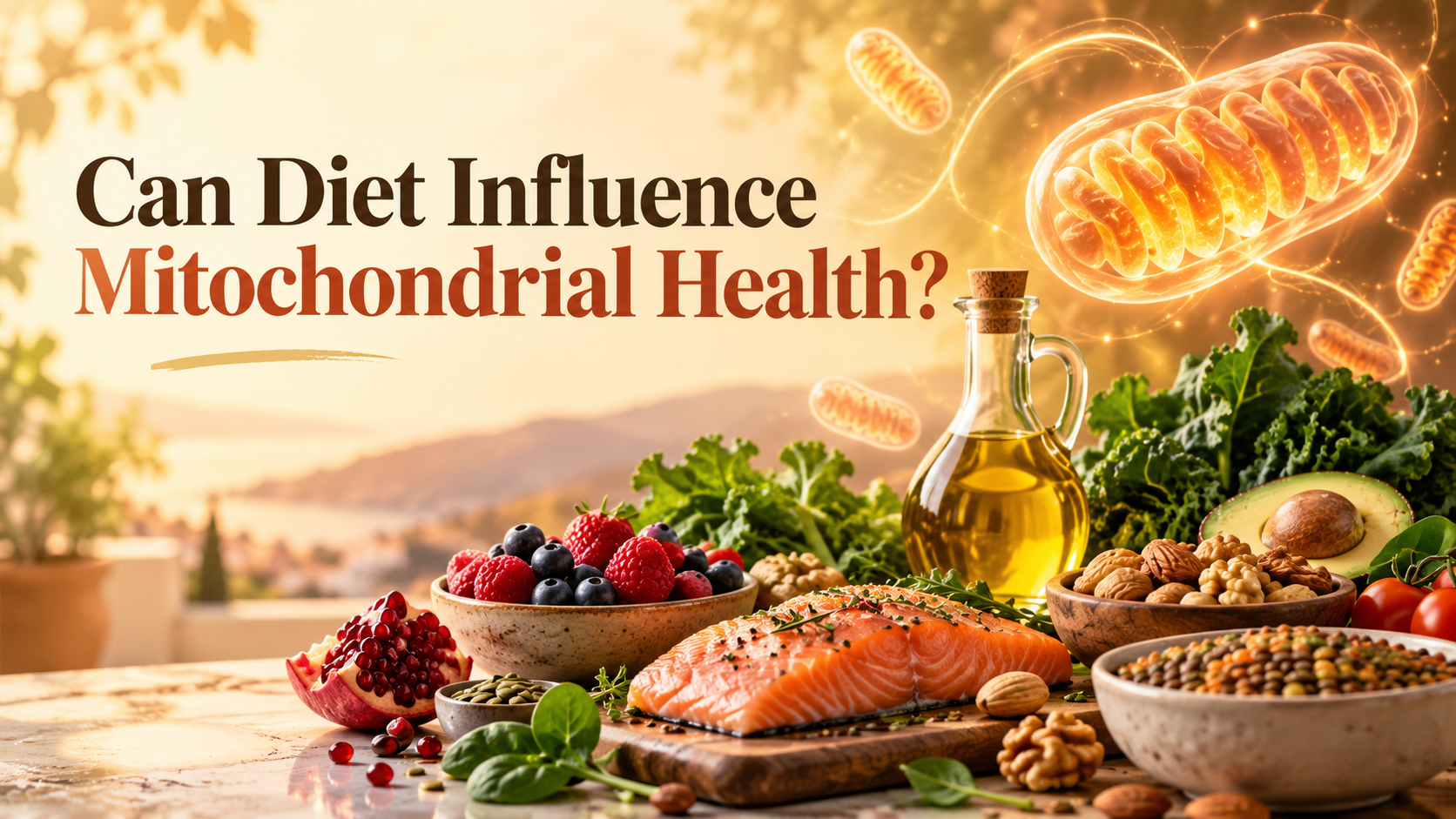
Beyond Protein: Can Your Diet Influence Mitochondrial Health?
New research explores how dietary patterns may relate to Humanin, SHMOOSE, and cellular protection.
Most people think of food as fuel. Protein helps build and maintain tissue. Carbohydrates and fats provide energy. Vitamins and minerals support essential chemical reactions.
But food may have another role: influencing how cells respond to stress.
A small study published in Frontiers in Nutrition in March 2026 found that older adults who more closely followed a Mediterranean-style diet had higher circulating levels of two mitochondrial microproteins called Humanin and SHMOOSE.
The same group also had lower levels of two markers associated with oxidative stress.
These findings raise an intriguing question: Could the foods we eat influence some of the body’s internal protective signals?
The answer is promising, but preliminary.
Mitochondria Do More Than Produce Energy
Mitochondria are best known for producing much of the energy our cells use.
They also participate in cellular communication, metabolism, and responses to physiological stress.
Some mitochondrial DNA sequences encode very small proteins, often called mitochondrial-derived peptides or microproteins.
Two of these are Humanin and SHMOOSE.
What Is Humanin?
Humanin is a small peptide encoded within mitochondrial DNA. Laboratory and animal research has linked it to cellular stress responses, metabolic regulation, and protection against certain forms of cellular injury.
Researchers are also investigating its potential involvement in cardiovascular and brain health.
However, demonstrating protective effects in cells or animals does not establish that increasing Humanin will prevent disease in humans.
What Is SHMOOSE?
SHMOOSE is another mitochondrial microprotein researchers are studying for possible roles in cellular maintenance and neurological health.
Research on SHMOOSE is relatively new. Scientists are still determining how its circulating levels relate to tissue function and whether changing those levels has meaningful health benefits.
Neither Humanin nor SHMOOSE is currently an established routine clinical marker of mitochondrial health.
What Did the Mediterranean Diet Study Find?
Researchers studied 49 adults with atrial fibrillation, a common heart rhythm disorder. Their average age was approximately 78 years.
Participants completed a Mediterranean diet questionnaire and were classified by how closely their usual eating habits matched the dietary pattern.
The investigators then measured Humanin, SHMOOSE, and two markers related to oxidative stress.
Compared with participants with lower dietary adherence, those with higher adherence had:
- Higher circulating Humanin.
- Higher circulating SHMOOSE.
- Lower levels of a marker associated with Nox2 activity.
- Lower levels of a lipid oxidation marker.
The researchers also found associations with individual foods.
Olive-oil consumption was associated with higher Humanin and SHMOOSE. Fish and legumes were associated with higher Humanin, while less refined bread was associated with higher SHMOOSE.
These results do not mean that eating a tablespoon of olive oil directly increases Humanin or that eating legumes improves mitochondrial function.
The participants were not assigned different diets, and the researchers did not measure changes in mitochondrial energy production.
The results show associations that need to be tested in larger, controlled studies.
What Does Oxidative Stress Have to Do With This?
Our cells continuously produce reactive oxygen species during normal metabolism and immune activity.
These molecules are not inherently harmful. In appropriate amounts, they participate in important signaling and defense functions.
Problems may develop when reactive oxygen species production exceeds the body’s ability to regulate and manage them.
Nox2 is one enzyme system involved in generating reactive oxygen species.
In this study, participants with higher circulating Humanin tended to have lower levels of a marker associated with Nox2 activation.
That finding raises the possibility that Humanin participates in pathways related to oxidative-stress regulation.
But an important distinction remains: the study did not prove that Humanin reduced Nox2 activity or prevented cardiovascular disease.
Food Is More Than Fuel: The Importance of Nutritional Signaling
One useful way to understand nutrition is to distinguish three different functions.
First, food provides building materials. Protein, fats, carbohydrates, vitamins, and minerals help maintain normal cellular functions.
Second, food contains compounds that can participate in biological signaling. Certain fatty acids, plant compounds, and other dietary constituents interact with pathways involved in metabolism and cellular regulation.
Third, the body must be able to process and tolerate what it consumes. A food cannot provide its intended nutritional value if poor intake, malabsorption, or significant digestive intolerance prevents adequate nourishment.
The Mediterranean diet study offers preliminary human evidence consistent with a relationship between dietary patterns and mitochondrial signaling.
It does not tell us which dietary components are responsible or whether changing those components will improve clinical outcomes.
What About Digestion and Gut Health?
The foods commonly found in Mediterranean-style eating patterns—vegetables, legumes, olive oil, fish, fruit, and nuts—can provide important nutrients and dietary bioactives.
Fiber-containing foods can also influence intestinal microbial metabolism, although this particular study did not measure the microbiome.
For someone with a healthy digestive system, a varied diet that provides adequate protein, healthy fats, and plant foods may be practical.
For someone with IBS, SIBO, intestinal methanogen overgrowth, reflux, or significant food intolerance, the situation can be different.
For example, legumes may be nutritionally valuable but also increase gas or bloating in people who are sensitive to fermentable carbohydrates.
This does not mean legumes are inherently unhealthy. It means that nutritional value and digestive tolerance are separate considerations.
The appropriate diet is not simply the one associated with favorable results in a population study. It must also provide enough nutrition without creating unnecessary symptoms or restriction.
How This Connects to Healing in Order
One principle within the Ettinger Foundation Protocol (EFP) is that capacity requires substrate.
In practical terms, the body needs enough nutritional resources to support its normal functions.
But supplying nutrients is only part of the picture.
The body must also digest, absorb, transport, and use those nutrients. Meanwhile, metabolic and cellular signaling systems help coordinate how those resources are managed.
The Humanin and SHMOOSE study illustrates why researchers are increasingly interested in nutrition as more than a source of calories and protein.
It does not validate the EFP’s phase sequence or establish that changing mitochondrial microprotein levels improves recovery.
Instead, it reinforces a useful question: Are we considering both nutritional adequacy and the body’s ability to make effective use of its nutritional environment?
For patients with complex digestive or multisystem illness, that distinction may be more clinically useful than simply adding another supplement or restrictive diet.
Should You Switch to a Mediterranean Diet to Increase Humanin?
Not based on this study alone.
Mediterranean-style dietary patterns have a broader research base supporting cardiovascular and metabolic health. But the evidence for changing Humanin or SHMOOSE through diet remains preliminary.
This small study cannot establish:
- That Mediterranean-style eating causes Humanin or SHMOOSE to increase.
- That either microprotein directly reduces oxidative stress in patients.
- That higher circulating levels necessarily mean better mitochondrial function.
- That particular foods prevent Alzheimer’s disease or cardiovascular events through these peptides.
- That Humanin or SHMOOSE supplements improve human health.
- That everyone with digestive symptoms should eat more legumes, grains, or fiber.
The study’s dietary questionnaire also included wine consumption as one scoring item. That should not be interpreted as a recommendation to drink alcohol for mitochondrial health.
What Can We Take Away Today?
The most practical lesson is not to chase a particular peptide level.
It is to recognize that dietary quality, nutrient sufficiency, and digestive tolerance all matter.
For many people, reasonable priorities include eating enough protein and energy, choosing a variety of nutrient-dense foods, and using a dietary pattern that is sustainable and medically appropriate.
For people with significant gastrointestinal symptoms, improving tolerance and maintaining adequate intake may need to come before expanding food variety.
Research on Humanin and SHMOOSE may eventually help scientists understand how diet influences mitochondrial stress responses. At present, that connection remains an emerging area of investigation.
Final Perspective
Food provides the materials our cells need, but nutrition may also influence the biological signals that help cells respond to their environment.
The 2026 Humanin and SHMOOSE study offers an early human observation supporting this broader concept.
It does not establish a new treatment or a new mitochondrial-health test.
The principle worth remembering is simple: Good nutrition involves what we consume, what we can tolerate, and how the body uses what becomes available.
Research Source
Vicinanza R, Cammisotto V, Wan J, et al. Mediterranean diet adherence is associated with mitochondrial microproteins Humanin and SHMOOSE; potential role of the Humanin–Nox2 interaction in cardioprotection. Frontiers in Nutrition. 2026;12:1727012.





Leave a Comment