How Intermittent Fasting Changed the Gut-Brain Pain Pathway
Chronic pain rarely stays confined to the place that hurts. Over time, it can affect sleep, mood, concentration, memory, and the way the nervous system responds to everyday demands.
New research suggests that part of this broader effect may involve an unexpected connection among the gut microbiome, microbial metabolites, and immune signaling within the nervous system.
In a 2026 study published in Brain, Behavior, and Immunity, researchers found that intermittent fasting improved neuropathic pain and cognitive problems in animal models. More importantly, they identified a possible biological chain connecting the fasting pattern to those improvements.
The pathway was not simply:
fasting → less pain.
Instead, the evidence pointed toward:
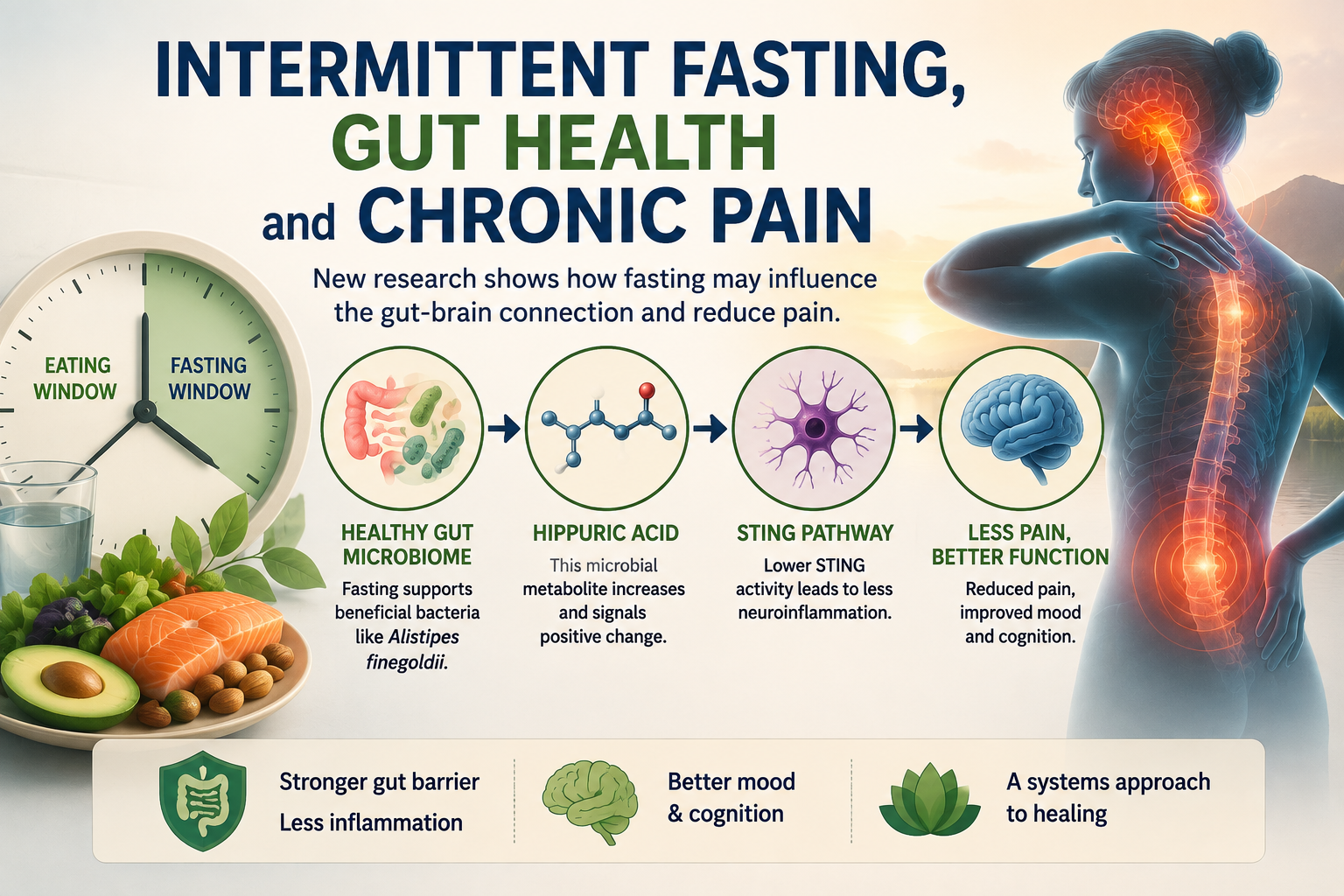
intermittent fasting → altered gut microbiome → increased hippuric acid → reduced STING signaling → less neuroinflammation → improved pain and cognitive function.
That distinction makes this study particularly interesting.
What Did the Researchers Actually Find?
The researchers tested intermittent fasting across several animal models of chronic pain.
The fasting intervention reduced two measures of heightened pain sensitivity: mechanical allodynia and thermal hyperalgesia. The animals also performed better on measures of cognitive function. In the chronic constriction injury model, anxiety-like behavior improved as well.
However, the researchers did not stop with behavior.
They looked for the physiology connecting the intervention to the outcome.
Intermittent fasting strengthened intestinal barrier integrity, altered the gut microbiome, and reduced neuroinflammation. One bacterial species repeatedly increased: Alistipes finegoldii.
That gave them another question:
Was this bacterium simply associated with improvement, or was it participating in the process?
A Gut Bacterium Reproduced Part of the Effect
The researchers gave live Alistipes finegoldii to the animals.
Remarkably, the bacterium reproduced important parts of the fasting response, including improvements in pain and cognition.
That finding moved the research beyond the simple observation that fasting changes the microbiome.
Still, the bacterium itself was not the end of the story.
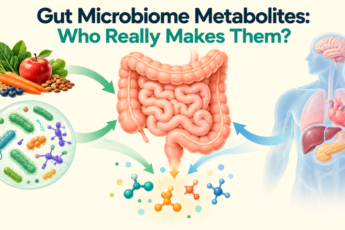
The researchers then examined metabolites—small molecules produced through interactions between microbes, food, and the host.
One stood out: hippuric acid.
Hippuric Acid Became the Metabolic Link
Hippuric acid increased in response to intermittent fasting and emerged as a key metabolite associated with the beneficial response.
When researchers administered hippuric acid systemically, it reproduced improvements in pain, cognition, and anxiety-like behavior in the chronic constriction injury model.
The investigators also found an association between A. finegoldii abundance and serum hippuric acid. Genomic analysis suggested that the bacterium may possess enzymes capable of producing benzoate-related precursors that the host could then convert into hippuric acid.
Importantly, that microbial production pathway was predicted rather than directly established.
This distinction matters.
The study does not simply tell us that a particular bacterium is “good.”
Instead, it points toward something more useful:
What microbes do may matter as much as which microbes are present.
The STING Pathway Connected the Gut to Neuroinflammation
The final piece involved STING, short for Stimulator of Interferon Genes.
STING is part of innate immune signaling. When excessively activated in the wrong context, it can contribute to inflammatory signaling.
Both intermittent fasting and hippuric acid reduced STING pathway activity in this study. Then the researchers deliberately activated STING pharmacologically.
The benefits of hippuric acid disappeared.
That experiment is important because it provides stronger mechanistic evidence than a simple correlation.
The proposed chain therefore becomes:
microbial change → metabolic signal → neuroimmune regulation → altered pain and cognitive behavior.
Why This Matters Beyond Fasting
It would be easy to read this paper and conclude that the lesson is simply to practice intermittent fasting.
That would go beyond the evidence.
These experiments were largely performed in animals with experimentally induced chronic pain. Therefore, the study does not establish that intermittent fasting will treat neuropathic pain, cognitive impairment, or anxiety in humans.
The deeper finding is about biological communication.
The gut microbiome does not influence the body only by occupying space in the intestine. Microbes participate in metabolism. Those metabolites can enter circulation and potentially influence immune signaling far beyond the gut.
In this experiment, changing the dietary pattern altered the microbial environment. The altered environment changed metabolic signaling. That signal then affected a neuroimmune pathway associated with pain and cognition.
The intervention changed the environment, and the environment changed the response.
That is considerably more interesting than fasting alone.
The Gut Microbiome Is a Functional System
Microbiome discussions often focus on lists of organisms:
Which bacteria are high?
Which bacteria are low?
Which probiotic should replace them?
This research suggests another way to think about the microbiome.
A functional microbiome is not defined only by which organisms are present. It is also defined by what those organisms are doing.
Two people could theoretically contain similar organisms while producing different metabolic outputs because diet, substrate availability, host physiology, microbial interactions, and other environmental conditions differ.
Therefore, microbiome function may sometimes matter more than microbiome inventory.
That principle could eventually change how we interpret microbiome testing and treatment, although this particular animal study cannot establish how those concepts should be applied clinically in humans.
Why Pain Can Become More Than Pain
The findings also help explain an observation familiar to people living with chronic pain.
Pain can begin as one problem and gradually become many.
Concentration becomes harder. Memory feels less reliable. Anxiety increases. The digestive system changes. Stress becomes harder to tolerate.
This does not mean every symptom originates in the gut.
However, this study demonstrates one biological route through which intestinal changes, microbial metabolism, neuroimmune activation, pain, and cognition can become connected.
The body does not always organize illness according to the specialties we use to describe it.
Gut physiology, immune signaling, brain function, and pain regulation can participate in the same biological network.
What This Means for My Book Healing in Order and the Ettinger Foundation Protocol (EFP)
Healing in Order is built on the idea that a symptom may be the visible expression of physiology occurring elsewhere in the system.
The painful nerve is real.
The cognitive difficulty is real.
The anxiety-like response is real.
Yet treating each manifestation as a completely independent problem can overlook the physiology that connects them.
In this study, altering the dietary environment affected the intestinal barrier and microbiome. Microbial and metabolic changes then influenced neuroimmune signaling. Finally, pain and cognitive behavior changed.
That is a systems problem rather than a single-symptom problem.
It also reinforces another EFP principle: changing the biological environment can sometimes be more important than directly attacking the downstream symptom.
Where This Fits in the EFP
For EFP, this research belongs primarily in Phase 2: Immune-Gut Stability.
The strongest reason is not that fasting changed the microbiome. It is the mechanistic connection among intestinal barrier integrity, microbial ecology, microbial metabolism, inflammatory signaling, and downstream neuroimmune effects.
A secondary connection exists with Phase 1 because pain sensitization and neuroimmune signaling can influence nervous-system regulation.
However, this paper should not move intermittent fasting into Phase 1 or Phase 2 as a routine intervention.
That would confuse a mechanistic finding with a clinical protocol recommendation.
In a sensitized or physiologically fragile person, fasting itself may represent a meaningful metabolic stressor.
The EFP question therefore remains:
Is this intervention appropriate for this system at this point in its recovery?
The sequence still matters.
What This Research Changes
This paper does more than confirm that the microbiome matters.
I would classify it as Existing EFP Concept Strengthened + Existing EFP Concept Refined.
The strengthened concept is the relationship among gut physiology, immune regulation, and downstream neurological function.
The refinement is more important:
Microbiome recovery should not be understood solely as changing microbial composition. Restoring beneficial microbial function and metabolic signaling may be equally important.
That is a useful evolution of the EFP interpretation.
It shifts attention from:
Who is there?
toward:
What is the microbial ecosystem producing, and what signals are those products sending to the rest of the body?
The Practical Meaning
The practical lesson is not that everyone with chronic pain should begin intermittent fasting or take Alistipes finegoldii or hippuric acid.
The research is not ready to support those conclusions.
Instead, it gives us a better model.
- Food timing can alter the intestinal environment.
- The intestinal environment can alter microbial behavior.
- Microbial behavior can change metabolites.
- Those metabolites can influence immune signaling.
- Immune signaling can affect systems far removed from the intestine, including the nervous system.
Therefore, when a chronic condition involves multiple systems, the connections among those systems may matter as much as the individual symptoms.
What This Study Does—and Does Not—Show
The study provides strong preclinical evidence that intermittent fasting can alter a gut microbial-metabolic-neuroimmune pathway in animal models of chronic pain.
It also provides mechanistic evidence implicating A. finegoldii, hippuric acid, and STING signaling.
However, it does not establish that:
- intermittent fasting treats neuropathic pain in humans;
- A. finegoldii should be used as a probiotic;
- hippuric acid should be supplemented;
- STING should currently be targeted clinically for chronic pain; or
- fasting is appropriate for every person with chronic illness.
Those questions require further human research.
Final Perspective
The most important part of this study may not be intermittent fasting at all.
It may be what happened after the dietary environment changed.
The microbiome changed. A microbial-associated metabolite changed. Neuroimmune signaling changed. Then pain and cognitive behavior changed.
That sequence gives us a more complete way to think about recovery.
Sometimes the symptom we feel most strongly is several biological steps downstream from the place where the system first needs help.
And sometimes improving that upstream environment changes more than one symptom because those symptoms were never truly separate problems in the first place.
Research Source
Ding X, Qiu D, Li X-Y, et al.
Intermittent fasting alleviates neuropathic pain and cognitive deficits via an Alistipes finegoldii–Hippuric Acid–STING neuroimmune axis.
Brain, Behavior, and Immunity. 2026;138:106949.
DOI: 10.1016/j.bbi.2026.106949
Gut–Brain Axis Dysfunction: Why Digestive Symptoms Are Not Just About Digestion