Firstly, you eat a meal that should not cause a problem. However, for many people, the relationship between gut bacteria and IBS pain can mean unexpected discomfort after eating.
Soon afterward, your abdomen begins to tighten. Pressure builds. Gas that should feel mildly uncomfortable becomes painful. The same food you tolerated last week may suddenly trigger cramping, bloating, or an urgent need to find a bathroom.
Testing may show no ulcer, obstruction, infection, or visible damage. Despite the pain being real.
However, for some people with irritable bowel syndrome, the problem may not be the food alone. It may be what their gut bacteria produce after the food reaches the gut.
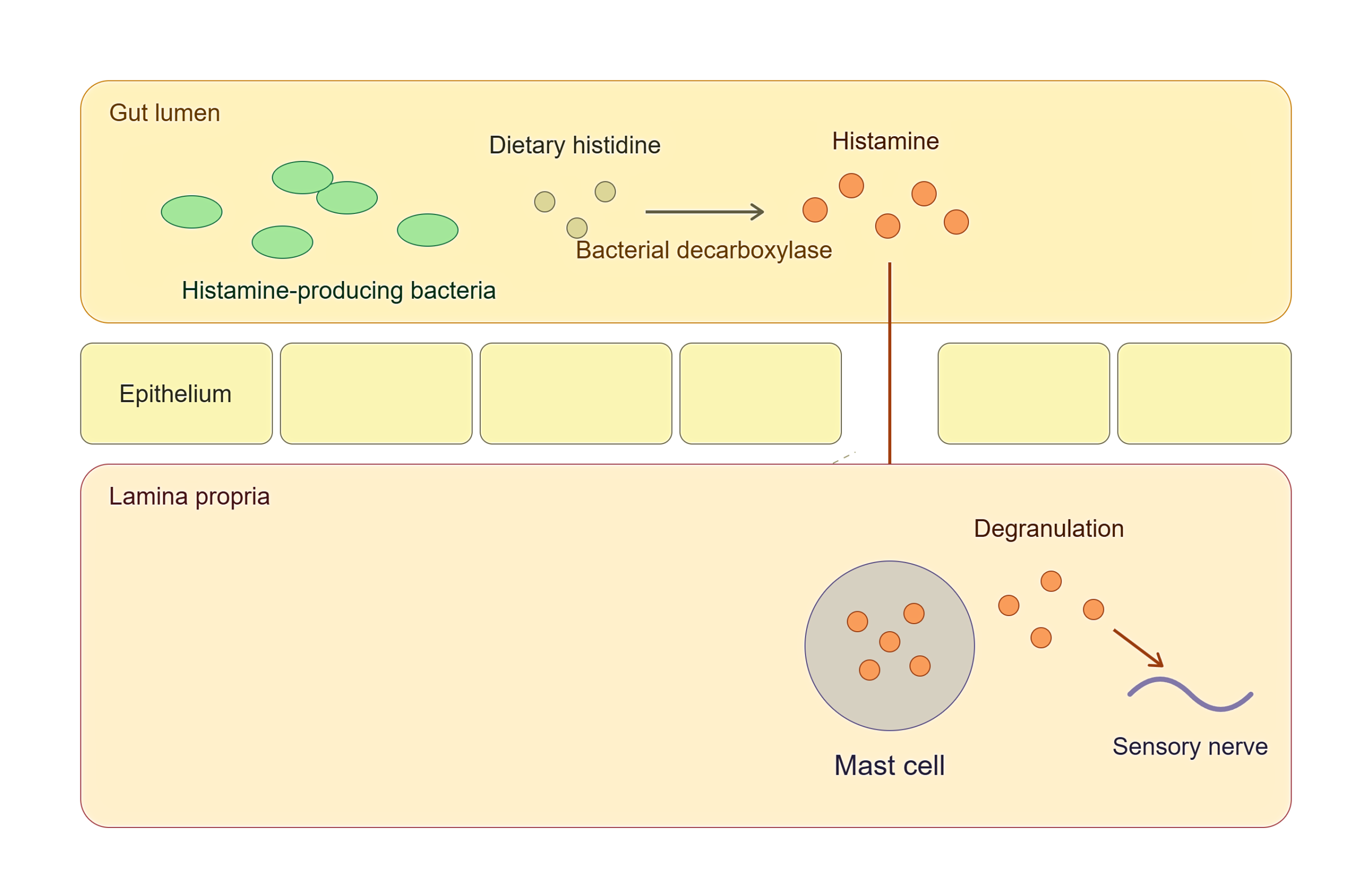
Research suggests that certain gut bacteria can produce histamine. That histamine may attract mast cells to the colon and make the intestinal nerves more sensitive. Once this happens, normal digestion can begin to hurt.
All in all, this does not mean that every case of IBS is caused by histamine. It does suggest that gut bacteria and IBS pain may be connected through a microbial, immune, and nerve-signaling pathway in a subset of patients.
What Is Visceral Hypersensitivity?
Pain is designed to protect us.
When tissue is injured, sensory nerves send warning signals to the brain. But the amount of pain a person feels does not always match the amount of visible injury.
Visceral hypersensitivity occurs when the nerves that monitor the internal organs become unusually sensitive to pressure, stretching, movement, or chemical signals.
When these nerves become sensitized:
- A normal amount of gas may feel excessive.
- Ordinary intestinal movement may cause cramping.
- Mild bloating may become painful.
- A routine bowel movement may create urgency or discomfort.
- Foods that were once tolerated may become unpredictable.
The intestine may look normal during an endoscopy or scan, yet the system controlling sensation has changed.
This is one reason people with IBS are sometimes told that nothing is wrong. The structure may appear intact, but the communication between the gut, immune system, and sensory nerves may no longer be working normally.
How Can Gut Bacteria Produce Histamine?
Histamine is best known for its role in allergies. It can contribute to itching, flushing, swelling, nasal congestion, and other immune reactions.
But histamine has several jobs in the body. It also affects stomach-acid production, blood vessels, immune-cell behavior, and nerve signaling.
Most discussions about histamine focus on two sources:
- Histamine already present in food
- Histamine released by mast cells
There is also a third possible source.
Some intestinal bacteria can convert the amino acid histidine into histamine.
They do this through an enzyme called histidine decarboxylase. The amount of histamine produced may depend on which organisms are present, which genes they carry, what foods reach them, and the conditions inside the intestine.
This means that a person may not react only to the histamine contained in food. Their intestinal ecosystem may produce additional histamine after a meal.
What Did the IBS Histamine Study Find?
Researchers examined fecal microbial communities from patients with IBS who had either high or low urinary histamine levels.
They transferred these microbial communities into germ-free mice. Germ-free mice are raised without an established microbiome, allowing researchers to study how a specific transferred microbial community affects physiology.
The mice receiving microbiota from patients with high urinary histamine developed greater visceral pain sensitivity and increased mast-cell activity. The mice receiving microbiota from patients with low urinary histamine did not develop the same response.
The researchers also found that the high-histamine microbial communities produced large amounts of histamine outside the body.
One bacterium, Klebsiella aerogenes, was identified as a major histamine producer. The strain carried a variation of the histidine decarboxylase gene that allowed it to generate substantial amounts of histamine.
The researchers then blocked the histamine H4 receptor. This reduced visceral hypersensitivity and decreased mast-cell accumulation in the colons of the mice.
Together, the results suggest the following sequence:
Gut bacteria produce histamine → histamine activates H4 receptor signaling → mast cells gather in the colon → intestinal nerves become more sensitive → normal digestive pressure becomes painful.
The study does not prove that this pathway causes every case of IBS. It does provide a clear biological mechanism that may be active in a subgroup of people who present with this strain of gut bacteria and IBS pain.
Read the original study in Science Translational Medicine.
What Is the Connection Between Histamine and IBS?
The connection between histamine and IBS is not as simple as saying that a person has too much histamine.
Several different mechanisms can produce histamine-related symptoms:
- Histamine may enter through food.
- Mast cells may release histamine within the intestinal lining.
- Histamine-degrading capacity may be reduced.
- Gut bacteria may produce histamine from histidine.
- Intestinal nerves may become unusually responsive to histamine.
- Several of these mechanisms may occur at the same time.
This distinction matters.
A low-histamine diet may help someone whose symptoms are strongly influenced by histamine already present in food. It may be less effective when bacterial production, fermentation, motility, or mast-cell recruitment is the primary driver.
The phrase “histamine intolerance” may therefore describe a symptom pattern without explaining where the histamine is coming from or why the body has become so reactive to it.
Why Fermentable Carbohydrates May Increase IBS Pain
The researchers had previously observed that reducing fermentable carbohydrates improved abdominal pain in some patients with IBS. Those improvements were associated with changes in the gut microbiome and lower urinary histamine.
In the newer study, mice carrying high-histamine-producing IBS microbiota also improved when they were fed fewer fermentable carbohydrates. Visceral hypersensitivity and mast-cell accumulation decreased.
Fermentable carbohydrates include several types of short-chain carbohydrates often grouped under the term FODMAPs.
These carbohydrates are not inherently unhealthy. Many are found in nutritious foods. However, they are absorbed poorly in some people and are rapidly fermented by intestinal microbes.
Fermentation can increase:
- Gas production
- Fluid movement into the intestine
- Intestinal stretching
- Microbial activity
- Production of biologically active metabolites
For a person whose intestinal nerves are already sensitized, these effects can combine.
Fermentation increases pressure. Then, microbes produce chemical signals. Mast cells become more active. The sensory threshold drops. After that, a normal digestive event is then experienced as pain.
The food may be the input, but it is not necessarily the entire cause.
Why the Same Food Can Cause Different Reactions
People often assume that a food either agrees with them or does not.
Biology is rarely that fixed.
The same food can produce different reactions depending on:
- Intestinal transit time
- Constipation or diarrhea
- Current microbial activity
- Meal size
- Recent antibiotic use
- Stress physiology
- Sleep quality
- Mast-cell activation
- Hormonal changes
- The total fermentable load of the meal
- What was eaten earlier in the day
Two people can eat the same food and produce different microbial metabolites.
The same person can also respond differently from one week to the next because the receiving environment has changed.
This helps explain why food tolerance may seem inconsistent. The food has not necessarily changed. The condition of the system receiving it has.
Dietary Histamine and Bacterial Histamine Are Not the Same
Dietary histamine is already present in a food before it is eaten. It is commonly found in aged, cured, fermented, or poorly stored foods.
Then, bacterial histamine is made inside the digestive tract by organisms capable of converting histidine into histamine.
These mechanisms may overlap, but they are not interchangeable.
A person might tolerate some foods that contain histamine but react strongly to fermentable carbohydrates that increase microbial activity. Another person may respond primarily to dietary histamine. Someone else may have mast-cell activation that is only partly connected to the microbiome.
This is why broad food restriction can become misleading.
Which food caused the reaction?
A better question is:
What happened after that food entered this particular intestinal environment?
Why a Standard Antihistamine May Not Fully Help
Most common over-the-counter antihistamines block the histamine H1 receptor.
The pathway emphasized in this study involved the H4 receptor. Thus, the H4 receptor signaling helps regulate immune-cell movement and appears to participate in mast-cell recruitment and visceral pain sensitivity.
That does not mean H1 antihistamines are useless. Histamine can act through several receptors, and both H1 and H4 signaling may contribute to visceral hypersensitivity.
It does mean that a common antihistamine may address only part of the pathway.
H4 receptor antagonists are not currently established as routine treatment for IBS. The receptor-blocking results in this study came primarily from mouse experiments, so they should not be treated as a ready-made human protocol.
Does Finding Klebsiella Prove It Is Causing the IBS Pain?
No.
Surprisingly, finding Klebsiella aerogenes on a stool test does not prove that it is producing clinically important amounts of histamine.
Microbial behavior depends on more than the name of the organism.
Important factors include:
- Which strain is present
- Whether it carries the necessary histamine-producing genes
- Whether those genes are active
- How abundant the organism is
- Which nutrients are available
- Intestinal pH
- Interactions with other microbes
- Transit time and local environmental conditions
A microbiome report tells us who may be present, though it does not always tell us what those organisms are doing.
This is a critical difference between microbial composition and microbial function.
Treating every detected organism as a pathogen can lead to unnecessary antimicrobial use and may further disrupt the intestinal ecosystem.
What This May Look Like in a Patient
A bacterial-histamine mechanism may be worth considering when someone has several of the following features:
- IBS with chronic abdominal pain
- Bloating that feels more painful than expected
- Symptoms that worsen when fermentable foods are eaten
- Fluctuating tolerance whenever the same foods are consumed
- Partial improvement on a low-FODMAP diet
- Abdominal pain with flushing, itching, nasal symptoms, or headaches
- Suspected mast-cell reactivity
- Symptoms that change despite no new structural disease
- Pain triggered by normal intestinal pressure or movement
These findings do not confirm bacterial histamine production.
They suggest that the problem may involve more than a fixed food intolerance. The intestinal environment may be transforming ordinary inputs into exaggerated immune and sensory signals.
What You Can Do Now
The goal is not to remove every fermentable or histamine-containing food indefinitely.
The goal is to reduce excessive signaling, identify the main drivers, and gradually restore a more stable response.
1. Track the full symptom pattern
Record foods, meal size, symptom timing, bowel movements, abdominal pressure, sleep, stress, and non-digestive histamine symptoms.
Look for repeatable patterns rather than blaming every food eaten before a reaction.
2. Use a low-FODMAP diet as a structured trial
A temporary low-FODMAP diet may help determine whether fermentable carbohydrates are contributing to symptoms.
It should not automatically become a permanent diet. Foods should be reintroduced in a systematic way when symptoms become more stable.
Long-term restriction can reduce dietary variety and may not correct the reason the gut became reactive.
3. Address constipation or irregular transit
Slow intestinal transit gives microbes more time to ferment available material. Irregular motility can also change the environment in which intestinal organisms live.
Improving bowel regularity may reduce fermentation pressure and excessive metabolite production.
4. Avoid treating a stool-test name in isolation
The presence of a histamine-capable organism does not prove that it is the main cause of symptoms.
Test findings should be interpreted alongside symptoms, diet, transit time, microbial balance, and evidence of gut inflammation or immune activation.
5. Consider mast-cell involvement when the pattern fits
Digestive pain accompanied by flushing, itching, nasal congestion, headaches, or marked food reactivity may justify a broader clinical assessment.
Mast-cell involvement should be evaluated carefully rather than assumed from symptoms alone.
6. Rebuild food tolerance gradually
Symptom improvement from removing foods is not the same as restored digestive function.
Once the system becomes more stable, carefully planned reintroduction can help determine whether tolerance is returning.
The long-term goal is not a perfect avoidance list. It is a digestive system that can handle a wider range of normal inputs without repeatedly becoming overwhelmed.
Gut Bacteria and IBS Pain Are Part of a Larger Sequence
The most useful lesson from this research is not that everyone with IBS should fear histamine, FODMAPs, or Klebsiella.
The lesson is that abdominal pain can develop through a sequence:
Food enters the gut, then microbes transform it.
Histamine and other signals are produced, then immune cells respond.
Sensory nerves become more reactive, and lastly, normal digestion begins to hurt.
By the time the pain appears, the symptom may be several steps downstream from where the process began.
Additionally, treating pain alone often brings incomplete relief. It is also why removing more and more foods may reduce symptoms without restoring normal function.
This is why healing requires locating where the sequence became unstable.
Consequently, the body does not respond to food in isolation. It responds through the condition of the gut environment receiving it.