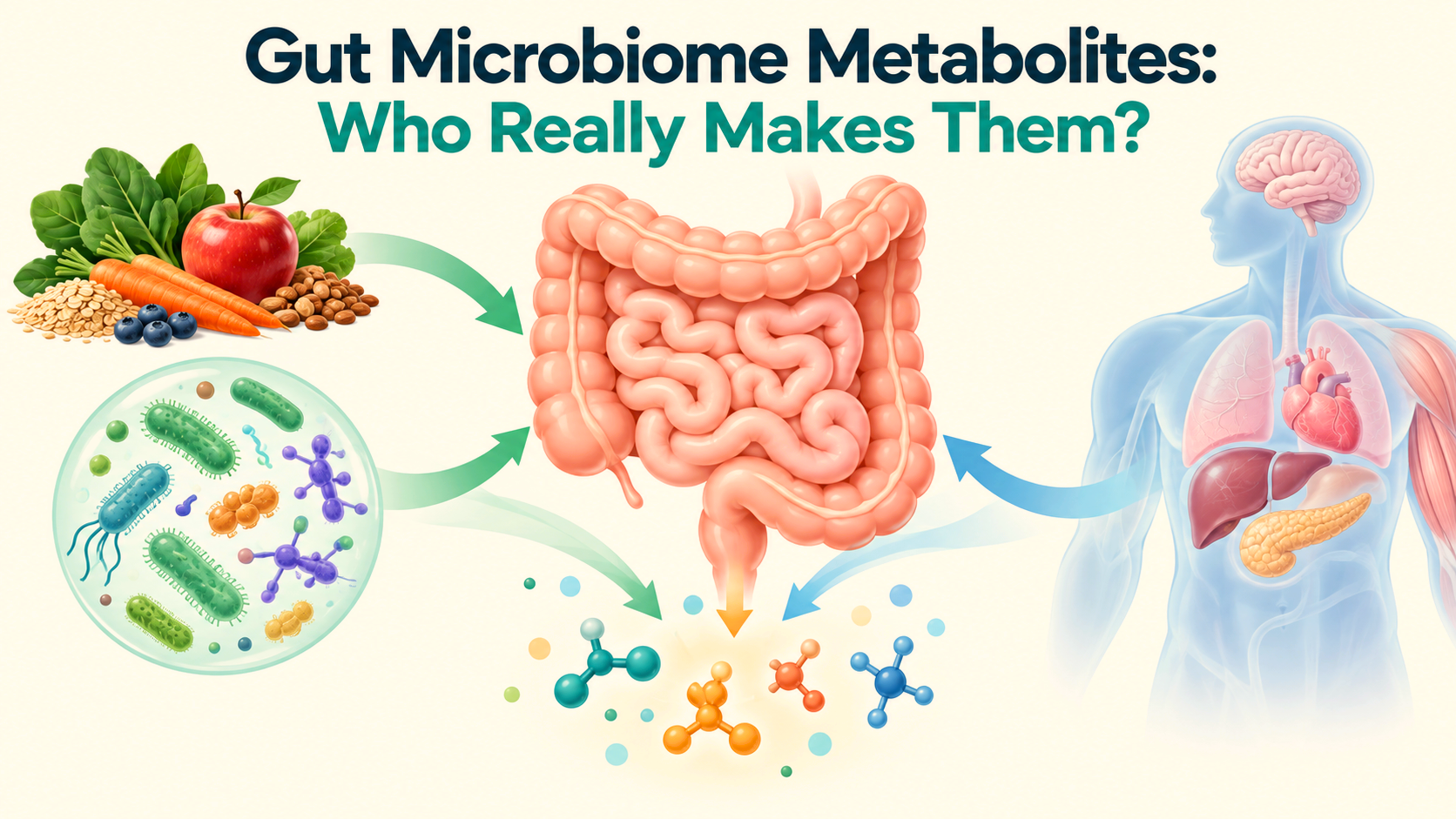
Gut Microbiome Metabolites: Who Really Makes Them?
When a blood, urine, or stool test finds a compound linked to the gut microbiome, it is tempting to assume that gut bacteria made it.
Sometimes that is true.
Sometimes it is not.
Two recent studies offer a more accurate view of gut microbiome metabolites. One shows that fiber and digestion-resistant protein can change what gut microbes use for fuel. The other shows that several metabolites often called “microbial” can also be made directly by our own tissues.
Together, they reveal an important principle:
The chemicals circulating through the body reflect an interaction among diet, gut microbes, and human metabolism—not the microbiome acting alone.
What Did the New Research Find?
Researchers at Princeton examined two different sides of the same problem.
In the first study, published in PNAS, investigators looked at how fiber and protein that resists digestion affect the colonic microbiome. They found that both can change microbial metabolism, but they do so in different ways.
Fiber reduced microbial use of host-secreted proteins such as mucin. At the same time, digestion-resistant protein delivered more phenylalanine to the microbiome. These changes shifted the metabolites that microbes produced.
The second study, published in Nature Metabolism, asked a different question:
Are the compounds commonly called microbial metabolites always made by microbes?
The answer was no.
Using stable isotope tracing and several experimental models, the researchers found that mammalian tissues can make substantial amounts of several indole and phenol metabolites independently of gut bacteria. Other metabolites, however, did require bacterial metabolism.
That distinction changes how these compounds should be interpreted.
What Are Gut Microbiome Metabolites?
Gut microbiome metabolites are chemicals produced or modified through interactions among food, intestinal microbes, and the human body.
That definition is more accurate than simply calling them “bacterial metabolites.”
For example, bacteria can metabolize amino acids that reach the colon. However, human tissues can metabolize the same amino acids through their own biochemical pathways.
As a result, the same compound may have more than one source.
This is why measuring a metabolite does not always tell us exactly where it came from.
Why Fiber Changes More Than Bacterial Numbers
Fiber is usually explained as food for beneficial bacteria.
That is true, but it is incomplete.
The PNAS study suggests that fiber also changes what microbes have to eat instead.
The intestine constantly produces mucus, which contains proteins that microbes can use as nutrients. When other fermentable substrates are available, microbes may rely less heavily on this host-derived material.
The researchers found that fiber reduced bacterial digestion of host-secreted proteins such as mucins and reduced production of certain tyrosine-derived phenol compounds.
So one way to think about fiber is:
More dietary substrate → less reliance on host-derived substrate → different microbial metabolism
That does not mean fiber protects every person’s mucus layer in the same way. The study does not establish that clinical conclusion.
However, it provides a better explanation for why fiber can change microbial behavior even when the major bacterial groups do not completely change.
Protein Reaching the Colon Is Not Always a Sign of Poor Digestion
Another important finding concerns protein.
We often think of protein as something the stomach and small intestine should fully digest and absorb.
Yet some proteins naturally resist digestion.
The PNAS investigators studied digestion-resistant protein that passed through the small intestine and reached the colonic microbiome. There, it became a source of amino acids for bacteria.
This means that protein in the colon does not automatically indicate digestive failure.
Food structure matters.
Protein type matters.
The surrounding food matrix matters.
Therefore, two diets containing the same total grams of protein may not provide the same amount or type of protein to the microbiome.
Your Own Cells Also Make “Microbial” Metabolites
The Nature Metabolism study produced perhaps the more surprising result.
Researchers traced amino acids through mammalian tissues and found that host metabolism can directly produce several compounds often discussed as gut microbial metabolites.
These included:
- indole-3-lactate
- indole-3-acetate
- indole-3-pyruvate
- indole-3-carboxylic acid
By contrast, compounds such as indole-3-propionate required microbial metabolism in the experimental systems.
That creates an important distinction.
A metabolite can be:
- mainly host-derived
- dependent on the microbiome
- produced by both.
That matters whenever blood or urine metabolomics are used to make claims about gut health.
Why Gut Microbiome Metabolites Can Be Misleading
Imagine a blood test showing an elevated indole metabolite.
The simple interpretation might be:
“Your bacteria are producing too much of this compound.”
But the new research shows why that conclusion may be premature.
The change could reflect:
- microbial metabolism
- human metabolism
- dietary intake
- intestinal substrate availability
- absorption
- liver processing
- kidney clearance.
Therefore, a metabolite concentration is an end result, not a full explanation.
That principle becomes even more important when trying to connect a metabolite to symptoms.
A laboratory result may be real while the assumed source is wrong.
Microbiome Composition Is Not the Same as Microbiome Function
This research also reinforces another important concept.
A stool test can tell us which organisms or microbial genes are present.
That does not automatically tell us how active they are.
Two people may carry similar bacteria but provide those bacteria with very different diets and substrates.
Therefore, their microbial output may differ substantially.
A more useful model is:
Who is there + what they are fed + what the host provides = what the ecosystem produces
This is why microbiome health cannot be reduced to a list of “good” and “bad” bacteria.
Function matters. Context matters. Substrate matters.
What Does This Research Mean for Diet?
These studies strengthen the idea that diet influences the microbiome through more than bacterial abundance.
Fiber changes the carbohydrate environment.
Digestion-resistant protein changes amino acid availability.
Together, those inputs influence what microbes metabolize and which compounds they produce.
However, the research does not establish an ideal fiber dose, plant-protein dose, or therapeutic diet.
It also does not prove that everyone should eat a plant-based diet.
The more defensible conclusion is simpler:
What reaches the colon helps determine what the microbiome does.
What This Research Does—and Does Not—Mean
These papers support several important conclusions.
They show that:
- diet changes microbial substrate availability
- fiber can alter microbial use of host proteins
- digestion-resistant protein can feed microbial amino acid metabolism
- host tissues can produce several metabolites previously attributed mainly to microbes
- some metabolites remain genuinely microbiome-dependent.
However, they do not show that:
- one metabolite can diagnose dysbiosis
- one bacterial family should be eliminated
- a specific protein supplement should be added
- every person should follow the same fiber intake
- a circulating metabolite directly explains a patient’s symptoms.
That distinction matters.
Mechanism improves understanding. It does not automatically become treatment.
Who Might Find This Most Relevant?
This research may be particularly useful for people trying to understand:
- microbiome testing
- stool metabolite results
- organic acid or metabolomic testing
- dietary fiber and gut health
- protein fermentation
- gut-kidney metabolism
- indole and phenol metabolites.
It is also relevant for anyone who has been told that a blood or urine metabolite proves that a specific bacterial imbalance is present.
The biology is more complex than that.
Practical Meaning
The most useful takeaway is not a new supplement or diet.
It is a better way to interpret gut biology.
When evaluating a metabolite, ask:
- Can the host make it?
- Does microbial metabolism contribute?
- What dietary substrate feeds the pathway?
- What host-derived substrate may be involved?
- How are absorption and clearance affecting the final level?
Those questions produce a much more reliable interpretation than assuming:
“The microbiome made it.”
Final Perspective
The gut microbiome is not an independent factory operating inside the body.
It is part of a shared metabolic ecosystem.
We feed it. Our intestinal tissues feed it. It transforms those materials. Then our own tissues modify, absorb, distribute, and clear the resulting compounds.
That means the chemistry we measure in blood, urine, or stool is rarely the product of one organism or one pathway.
The better question is not simply:
“Which bacteria made this?”
It is:
“What combination of diet, microbial activity, and host metabolism produced this result?”
That question is more accurate—and much more useful.
Research Sources
AbuSalim JE, MacArthur MM, Gupta M, et al. Digestion-resistant proteins support the healthy metabolite profiles associated with plant-based diets. Proceedings of the National Academy of Sciences. 2026;123(32):e2605226123. DOI: 10.1073/pnas.2605226123.
AbuSalim JE, Olszewski K, Youssef S, et al. Host metabolism can produce many indoles and phenols independently of the microbiome. Nature Metabolism. 2026;8:1528–1544. DOI: 10.1038/s42255-026-01550-8.




Leave a Comment