How Gut Transit Time Changes Your Microbiome
If you have IBS, SIBO, constipation, diarrhea, bloating, or abnormal stool-test results, it is easy to assume the bacteria on the test are the problem.
Sometimes they are part of the problem.
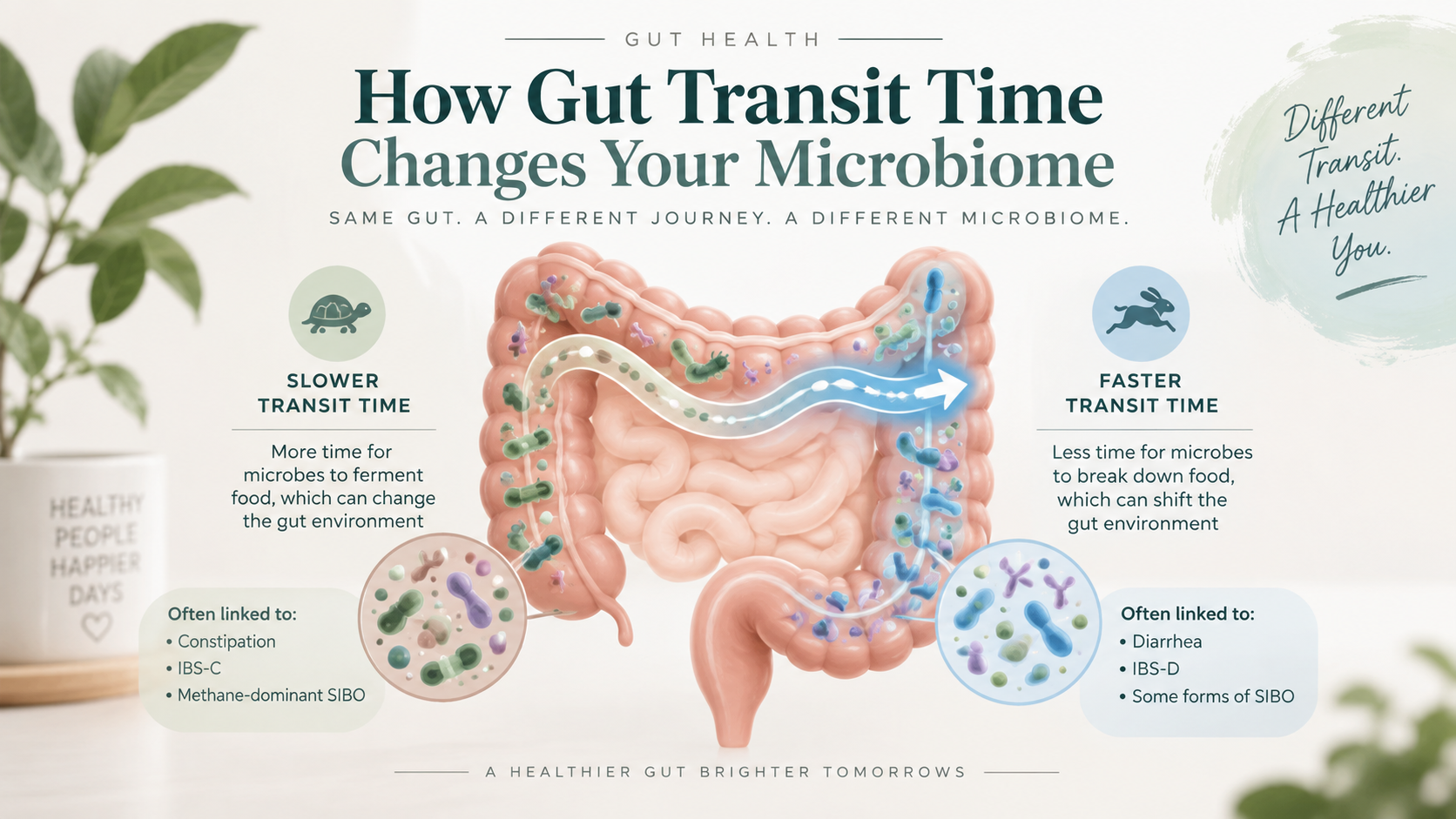
However, gut transit time and microbiome patterns are closely linked. How quickly or slowly material moves through your digestive tract can change which microbes thrive, what they produce, the pH of the colon, and even what eventually appears on a stool test.
That creates an important clinical question:
Is the microbiome causing the abnormal gut environment, or is the gut environment helping create the microbiome pattern?
Why Gut Transit Time Matters More Than Most People Realize
Gut transit time is the amount of time it takes material to move through the gastrointestinal tract.
Transit is not simply about how often you have a bowel movement. It changes the environment in which intestinal microbes live.
When transit slows, microbes have more time to interact with food residues, intestinal secretions, bile acids, mucus, and one another. As a result, the available nutrients change as material moves through the colon.
When transit speeds up, microbes have less time to grow, metabolize nutrients, and modify the intestinal environment.
Therefore, the microbiome is not sitting in a fixed container. It is living inside a constantly changing ecosystem.
What Happens to the Microbiome When Transit Is Slow?
Slow transit does more than leave stool sitting in the colon longer. It changes what microbes have available to eat.
Many intestinal microbes initially ferment carbohydrates that reach the colon, especially fermentable fibers. This process produces short-chain fatty acids such as acetate, propionate, and butyrate.
However, as material remains in the colon longer, fermentable carbohydrate can become progressively depleted. At the same time, short-chain fatty acids are absorbed through the colon.
Eventually, microbes have access to less carbohydrate. As a result, microbial metabolism can shift toward greater use of dietary and host-derived proteins.
This shift from saccharolytic fermentation, or carbohydrate fermentation, toward more proteolytic fermentation, or protein fermentation, can increase branched-chain fatty acids, ammonia, phenols, indoles, and hydrogen sulfide.
A microbiome can change its metabolism because transit changed the resources available to it.
Low Short-Chain Fatty Acids May Not Mean What You Think
Stool tests sometimes report low levels of short-chain fatty acids, including butyrate.
A common interpretation is that the bacteria are not producing enough butyrate.
That is one possibility, but it is not the only one.
With prolonged transit, lower fecal short-chain fatty acid levels may also reflect greater absorption, reduced carbohydrate availability later in the colon, or altered microbial fermentation.
What appears in the stool is not necessarily the same as what was produced inside the colon.
A stool sample shows us what reached the end of the digestive tract after microbial production, intestinal absorption, transit time, pH, diet, and bile-acid metabolism have already influenced it.
Slow Transit, Methane, and IMO
The relationship between methane and constipation is particularly important for people with intestinal methanogen overgrowth, or IMO.
Methane production has repeatedly been associated with constipation and slower intestinal transit. Experimental evidence also suggests that methane itself may reduce intestinal contractile activity.
This creates the possibility of a reinforcing cycle:
slower transit → an environment that favors methanogens → greater methane production → potentially slower motility
This relationship may work in both directions.
Therefore, when methane repeatedly returns after treatment, it is reasonable to ask not only how to reduce methane but also why the intestinal environment continues to favor methane production.
What About Fast Transit and Diarrhea?
The slow-transit microbiome has been studied more extensively than the fast-transit microbiome.
Still, with faster transit, stool generally contains more water, microbes have less time to grow and interact with substrates, and there is less time for extensive protein fermentation or microbial modification of bile acids.
Some studies have also associated shorter intestinal transit with lower microbial cell density and certain Bacteroides-dominant patterns. However, the evidence is not strong enough to define one universal fast-transit microbiome.
For patients with IBS-D or chronic diarrhea, an abnormal stool test may therefore partly reflect rapid transit rather than identify the original cause of the diarrhea.
Why Stool-Test Results Need Context
Microbiome reports often encourage us to look at organisms first.
However, the intestinal environment may help determine which organisms appear.
Transit time, stool consistency, available nutrients, intestinal pH, bile-acid metabolism, and microbial competition can all influence the final pattern.
Even microbial diversity needs context. Higher diversity is often presented as automatically healthier, yet longer transit has also been associated with greater microbial richness.
More diversity does not always mean better gut function.
The Microbiome and Transit Affect Each Other
The relationship does not move in only one direction.
Transit changes the microbiome, but microbes can also influence transit.
Microbial metabolism produces compounds including short-chain fatty acids, secondary bile acids, hydrogen, methane, tryptamine, and histamine.
These compounds can interact with intestinal epithelial cells, enteroendocrine cells, enteric nerves, smooth muscle, and gut hormones involved in motility.
A more accurate model is:
motility → intestinal environment → microbiome → microbial metabolites → motility
This feedback loop helps explain why some chronic digestive problems can persist even after the original trigger has changed.
Why This Matters for IBS and SIBO
For patients with IBS or SIBO, this changes an important part of the clinical conversation.
Suppose a stool test shows altered bacterial abundance, methane production, low short-chain fatty acids, or increased protein-fermentation products.
If significant slow transit is also present, another question should be asked:
Could abnormal transit be helping create these findings?
If so, repeatedly trying to manipulate the microbiome without addressing motility may leave part of the underlying ecological problem intact.
Likewise, in diarrhea, the microbiome may partly reflect rapid transit rather than independently causing it.
Could Disease-Associated Dysbiosis Sometimes Be a Transit Effect?
Many illnesses are associated with characteristic microbiome patterns. However, many of those same illnesses also alter bowel motility.
That creates two possible pathways:
disease → altered motility → altered microbiome
or:
altered microbiome → altered physiology → disease-associated changes
In some conditions, both may be occurring.
Therefore, finding an unusual microbiome in a disease does not automatically prove that the microbiome caused the disease.
What Should Be Considered Before Interpreting a Stool Test?
A stool test becomes more useful when it is interpreted alongside the physiology that produced the sample.
Before drawing strong conclusions, consider:
- Bowel movement frequency
- Usual Bristol stool form
- Constipation, diarrhea, or alternating patterns
- Methane or IMO status
- Recent dietary changes
- Medications that alter motility
- Whether bowel function during collection was typical
These factors help answer a more important question: Are we looking at the cause of the intestinal problem, or the microbial fingerprint of the environment created by it?
A Better Way to Think About the Gut Microbiome
The microbiome should not be viewed as a collection of organisms that simply need to be increased, decreased, or eradicated.
It is an ecosystem.
And ecosystems respond to their environment.
If intestinal transit changes, the environment changes. If the environment changes, microbial behavior changes.
A more useful clinical sequence is:
motility and transit → intestinal environment → microbial ecology → metabolites → symptoms and feedback
The direction will not be identical in every patient. Sometimes microbial changes may themselves contribute strongly to abnormal motility.
But the direction of causation should be investigated rather than assumed.
Transit should be interpreted before taxonomy.
Research Source
Procházková N, Falony G, Dragsted LO, Licht TR, Raes J, Roager HM. Advancing human gut microbiota research by considering gut transit time. Gut. 2023;72(1):180–191. DOI: 10.1136/gutjnl-2022-328166.
When digestive symptoms persist, it is easy to focus entirely on what is growing in the gut.
Sometimes the more useful question is why that particular ecosystem developed in the first place.
If treatment keeps focusing on bacteria while constipation, diarrhea, or abnormal motility remains unresolved, a broader assessment of what is shaping the intestinal environment may be warranted.





Leave a Comment