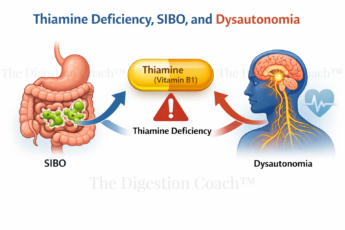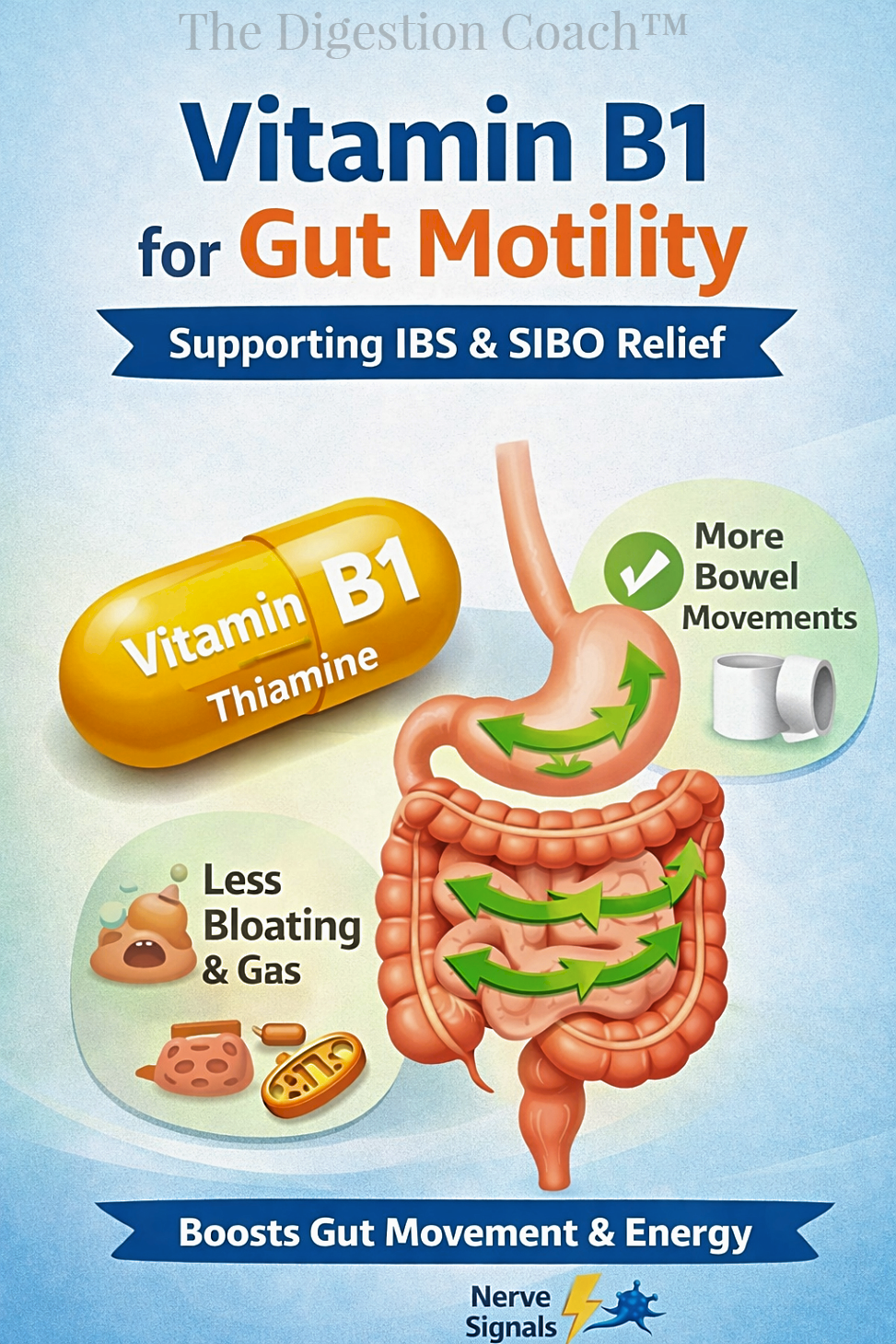
Vitamin B1 for gut motility may be an often-overlooked area of opportunity.
If you have IBS or SIBO, you may feel stuck after meals.
You may bloat fast.
You may feel backed up.
A common reason is slow motility.
Gut motility is the movement of food and waste through your digestive tract.
When motility works well, your gut moves forward on time.
As a result, you feel lighter and more regular.
When motility slows down, symptoms build.
This often shows up as gas, bloating, and constipation.
In this article, I will connect gut motility to IBS and SIBO.
I will also explain what a new 2026 study suggests about vitamin B1 (thiamine).
Finally, I will show you simple steps you can try.
Table of Contents
- What is gut motility?
- Why does gut motility matter for IBS?
- Why does gut motility matter for SIBO?
- What did the 2026 study find about vitamin B1?
- How might vitamin B1 help gut motility?
- What foods are high in vitamin B1?
- Should you take a vitamin B1 supplement?
- How to use vitamin B1 with an IBS or SIBO plan
- How to track results (so you know it is working)
- Key takeaways
- Next steps
What is gut motility?
Gut motility means movement.
It describes how your stomach and intestines push food forward.
It also describes how your body removes waste.
Motility is not only speed.
It also includes timing and coordination.
Because of that, you can have symptoms even if you go daily.
Common signs of slow gut motility include:
- Bloating after meals
- Feeling full too fast
- Constipation
- Hard stools
- Straining
- Feeling “not done” after a bowel movement
In other words, motility helps your gut stay on schedule.
When it falls behind, you often feel it quickly.
Why does gut motility matter for IBS?
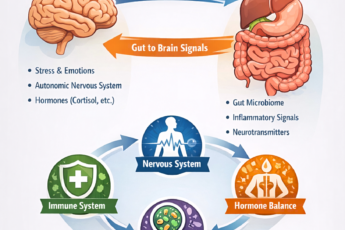
IBS affects digestion and the nervous system.
So, many people describe IBS as a gut-brain issue.
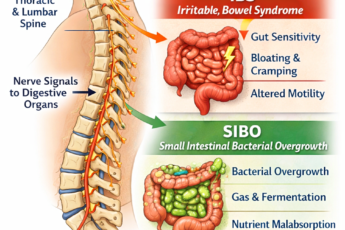
In IBS-C, slow transit is common.
Stool stays in the colon longer.
As a result, the colon pulls out more water.
That makes stool harder and harder to pass.
Slow transit can also increase abdominal pressure.
That pressure can cause abdominal pain.
Then stress signals can rise.
Over time, those stress signals may further slow motility.
For example, you may eat a normal meal and still feel heavy for hours.
You may also feel bloated even when you did not overeat.
Why does gut motility matter for SIBO?
SIBO means small intestinal bacterial overgrowth.
In simple terms, bacteria become too active in the small intestine.
A healthy gut has a built-in cleaning rhythm.
Clinicians call this rhythm the migrating motor complex (MMC).
The MMC runs between meals, not during meals.
The MMC acts like a sweep.
It helps move leftover food down and out.
It also helps move bacteria forward.
However, if the MMC slows down, food can sit longer.
Then bacteria can linger.
As a result, fermentation rises, and gas builds.
That is why meal spacing can help many SIBO cases.
It is also why motility support can matter after treatment.
What did the 2026 study find about vitamin B1?
A large 2026 study looked at diet and bowel habits.
It found a clear pattern.
People who ate more vitamin B1 (thiamine) tended to have more frequent bowel movements.
This study shows an association.
That means the two things happened at the same time.
It does not prove that vitamin B1 caused the change.
Even so, this matters for IBS and SIBO.
Constipation is common in IBS-C.
Constipation can also show up in many SIBO cases.
How might vitamin B1 help gut motility?
Vitamin B1 supports energy production in the body.
It also supports healthy nerve function.
Your gut needs energy to move.
It also needs nerve signals to coordinate movement.
So, thiamine may support the system that drives gut motion.
Vitamin B1 supports:
- Cell energy production
- Nerve-to-muscle signaling
- Normal muscle function
To be clear, vitamin B1 does not cure IBS.
It also does not treat SIBO on its own.
Instead, it may support motility as one helpful tool.
This can matter even more if your diet is limited.
It can also matter if your gut does not absorb nutrients well.
What foods are high in vitamin B1?
Food is a great place to start.
It is also easy to test.
First, add one vitamin B1 food daily.
Then, track what changes.
Top vitamin B1 foods include:
- Pork
- Fish (like trout or salmon)
- Lentils and beans
- Sunflower seeds
- Nuts and seeds
- Fortified grains (check labels)
- Whole grains
- Yogurt (small amounts, but easy daily use)
For example, you can add lentils to lunch.
Or you can add sunflower seeds to yogurt.
These changes are small, but they add up over time.
Should you take a vitamin B1 supplement?
Some people cannot get enough vitamin B1 from food alone.
This often happens with IBS and SIBO.
Restricted diets can lower intake.
Poor digestion can lower absorption.
In those cases, a supplement trial may help.
Ask your doctor if a trial is right for you.
Vitamin B1 is water-soluble.
Many people tolerate it well.
However, some people get mild stomach upset or headaches.
Rare allergic reactions can happen as well.
If you take medications or have complex health issues, talk with your clinician first.
That step keeps your plan safe and personalized.
How to use vitamin B1 with an IBS or SIBO plan
Vitamin B1 for gut motility works best as part of a full plan.
It does not replace proven IBS and SIBO protocols.
Keep these foundations in place:
- Low-FODMAP diet phases (when appropriate)
- Meal spacing (often 3–4 hours between meals)
- Prokinetics or herbal motility support (case-dependent)
- Stress reduction and vagus nerve support
- Targeted antimicrobials or probiotics (case-dependent)
- Sleep and circadian rhythm consistency
Next, add vitamin B1 support.
Start with food.
Then consider a supplement trial if needed.
This approach keeps the plan simple.
It also makes results easier to measure.
How to track results (so you know it is working)
Tracking turns symptoms into data.
Data helps you make better decisions.
Without tracking, you guess.
Track daily for 4–6 weeks:
- Bowel movements per day
- Stool form (Bristol Stool Scale)
- Bloating (0–10)
- Pain or pressure (0–10)
A common goal is 1–3 comfortable bowel movements per day.
You also want less straining during a bowel movement.
You also want less pressure.
For example, if stools become softer and easier to pass, that is progress.
If frequency improves but bloating persists, you may still need additional SIBO support.
Key takeaways
- Gut motility matters for IBS and SIBO.
- Slow motility can worsen constipation, gas, and bloating.
- A 2026 study linked higher vitamin B1 intake with more frequent bowel movements.
- Vitamin B1 may support motility, especially in IBS-C patterns.
- Food first is ideal. Supplements can help when diet and absorption fall short.
- Track results for 4–6 weeks to confirm real change.
Next steps
Start simple and stay consistent.
First, track your bowel habits for 7 days.
Next, add one vitamin B1-rich food daily.
Then, review your results after 2–4 weeks.
If you want a structured plan to support gut motility for IBS and SIBO, reach out to me.
I can personalize your next step based on your symptoms and history.
COMPLIMENTARY 15-MINUTE CALL
Take your first step toward a renewed sense of well-being. Call today to arrange a complimentary 15-minute consultation.
Let’s discern whether my approach aligns with your needs.
I look forward to connecting with you at 714-639-4360.
Dr. Marcus Ettinger – The Digestion Coach
See also CIRS: Expert Insights on Understanding Chronic Inflammation