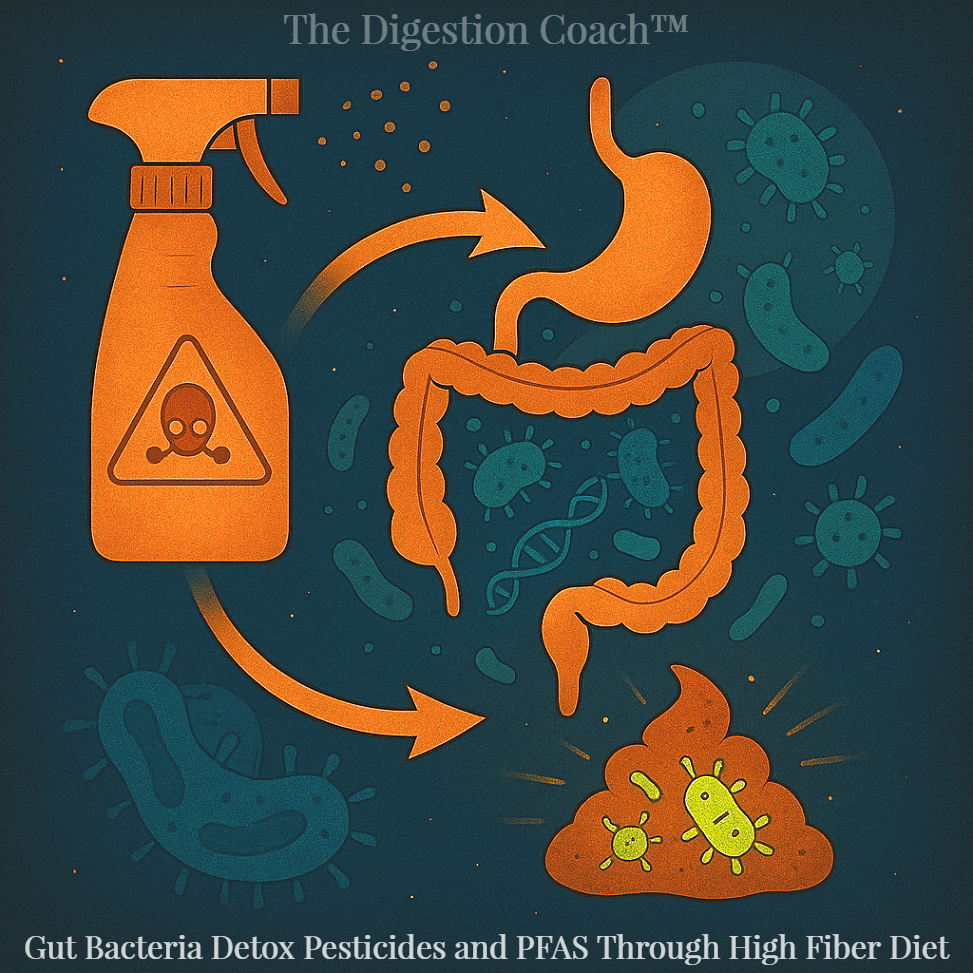
Introduction: Why Gut Bacteria Matter for Detoxification
Chemical pollutants such as pesticides and per- and polyfluoroalkyl substances (PFAS) are everywhere. They can be found in food, water, and household products. These toxins can accumulate in your body, disrupting gut bacteria and leading to inflammation. Two studies published in Nature Communications (2025) and Nature Microbiology (2025) demonstrate that gut bacteria detox pesticides and PFAS by bioaccumulating them. Bacteria such as Bacteroides ovatus and B. uniformis trap these toxins, potentially aiding in their excretion through microbiome detoxification. A fiber-rich diet can boost these bacteria. This post shares a simple dietary plan to support your gut microbiome, helping it tackle environmental toxins.
Table of Contents
- Introduction: Why Gut Bacteria Matter for Detoxification
- What Are Pesticides and PFAS, and Why Are They Harmful?
- Which Gut Bacteria Bioaccumulate Pesticides and PFAS?
- How Do Gut Bacteria Help with Toxin Excretion?
- What Foods Support Toxin-Bioaccumulating Bacteria?
- How Can You Add More Supportive Foods to Your Diet?
- Sample Daily Menu to Boost Your Gut
- What Else Can You Do to Reduce Toxin Exposure?
- Summary: Empower Your Gut for Detox
What Are Pesticides and PFAS, and Why Are They Harmful?
Pesticides protect crops but leave residues in food. PFAS, also known as “forever chemicals,” are found in non-stick pans and waterproof fabrics. Both accumulate in your body. They disrupt gut bacteria, reducing the production of beneficial compounds like short-chain fatty acids (SCFAs). This can lead to inflammation and health issues. A study published in Nature Communications reveals that pesticides alter bacterial metabolism. A study in Nature Microbiology finds that PFAS build up in bacteria, affecting gut health. Supporting your gut bacteria can reduce these effects.
Which Gut Bacteria Bioaccumulate Pesticides and PFAS?
Gut bacteria handle pesticides and PFAS by trapping them without breaking them down. The Nature Communications study tested 17 bacteria. Bacteroides ovatus bioaccumulates pesticides, such as 4,4′-DDE, most strongly. Other bacteria include:
- B. uniformis, B. thetaiotaomicron, B. caccae, B. fragilis, B. stercoris: These trap pesticides, altering metabolism.
- Parabacteroides distasonis, Bifidobacterium adolescentis: These also bioaccumulate pesticides.
- Faecalibacterium prausnitzii, Roseburia spp., Ruminococcus bromii, Eubacterium rectale: These show less accumulation but produce SCFAs.
- Akkermansia muciniphila: It supports gut health via mucin but has low pesticide accumulation.
The Nature Microbiology study found that B. uniformis, B. thetaiotaomicron, B. caccae, B. fragilis, B. stercoris, and P. distasonis bioaccumulate PFAS, including PFNA. B. ovatus likely does too, as a Bacteroidetes member. Others, such as F. prausnitzii and Bifidobacterium spp., exhibit minimal PFAS accumulation.
How Do Gut Bacteria Help with Toxin Excretion?
Bioaccumulation means bacteria trap toxins inside their cells. The Nature Communications study reveals that B. ovatus stores pesticides, thereby reducing their spread throughout the body. This alters bacterial pathways, lowering SCFA production. A study in Nature Microbiology found that B. uniformis and other bacteria concentrate PFAS, leading to increased fecal excretion in mice. A healthy gut microbiome can trap and remove toxins. Diet supports microbiome detoxification by providing fuel for bacteria.
What Foods Support Toxin-Bioaccumulating Bacteria?
A fiber-rich diet supports the growth of bacteria such as B. ovatus and B. uniformis. These foods provide substrates for SCFA production and support microbiome detoxification:
- High-Fiber Vegetables:
- Why: Pectin and hemicellulose fuel B. ovatus and B. uniformis. SCFAs reduce inflammation.
- What: Eat 3-4 cups daily of carrots, broccoli, spinach, or sweet potatoes (~10-15g fiber).
- Tip: Opt for organic to minimize pesticide exposure.
- Whole Grains:
- Why: Resistant starches support R. bromii and Roseburia spp. for butyrate production.
- What: Include 1.5-2 cups quinoa, barley, or oatmeal daily (~10-12g fiber).
- Tip: Use unprocessed grains for maximum benefit.
- Fruits:
- Why: Pectin and polyphenols aid B. ovatus and Bifidobacterium spp..
- What: Eat 2-3 servings of apples, berries, or bananas daily (~5-7g fiber).
- Tip: Wash fruits thoroughly or opt for organic options.
- Legumes:
- Why: Oligosaccharides boost B. uniformis and E. hallii for SCFAs.
- What: Include 1-1.5 cups lentils or chickpeas daily (~7-10g fiber).
- Tip: Soak legumes to ease digestion.
- Prebiotics:
- Why: Inulin supports F. prausnitzii and Bifidobacterium spp..
- What: Eat 1-2 servings of onions, asparagus, or flaxseeds daily (~3-5g fiber).
- Tip: Start slowly to avoid bloating.
How Can You Add More Supportive Foods to Your Diet?
Beyond fiber, other foods strengthen your gut:
- Nuts and Seeds:
- Why: Polyphenols aid B. ovatus and Prevotella spp..
- What: Eat ¼-½ cup walnuts or almonds daily (~2-4g fiber).
- Tip: Choose raw, unsalted nuts.
- Fermented Foods:
- Why: Probiotics support Bifidobacterium and F. prausnitzii.
- What: Include ½-1 cup yogurt or sauerkraut daily.
- Tip: Pick low-sugar options.
- Lean Proteins and Fats:
- Why: Proteins support mucin for A. muciniphila.
- What: Eat 4-6 oz chicken or salmon and 1-2 tbsp olive oil daily.
- Tip: Choose organic proteins.
- Hydration:
- Why: Water aids gut motility and mucin production.
- What: Drink 8-10 cups of water or tea daily.
- Tip: Use filtered water to reduce PFAS.
Sample Daily Menu to Boost Your Gut
Try this menu to support gut bacteria that detox pesticides and PFAS:
- Breakfast: ½ cup oatmeal with 1 tbsp flaxseeds, 1 apple, ½ cup Greek yogurt, 1 cup green tea.
- Snack: 1 orange, ¼ cup almonds.
- Lunch: Quinoa-lentil bowl (¾ cup quinoa, ¾ cup lentils, 2 cups greens with carrots), 3 oz tofu, 1 tbsp olive oil, ¼ cup sauerkraut.
- Snack: 1 slice rye bread with almond butter, 10 roasted chickpeas.
- Dinner: 3 oz salmon, ½ cup barley, 1 cup Brussels sprouts, ½ cup pomegranate seeds, 1 tbsp kimchi.
- Hydration: 8-10 cups of water.
What Else Can You Do to Reduce Toxin Exposure?
Diet alone isn’t enough. These steps help:
- Buy Organic: Organic foods have fewer pesticides and PFAS.
- Wash Produce: Rinse fruits and vegetables thoroughly.
- Filter Water: Use carbon or reverse osmosis filters for PFAS.
- Diversify Foods: Rotate choices to avoid repeated exposure.
- Check Gut Health: Consider stool tests to monitor your microbiome.
- In the Kitchen: Choose glass over plastic, ceramic, and stainless steel for cookware.
Summary: Empower Your Gut Supporting Microbiome Detoxification.
Gut bacteria detox pesticides and PFAS by trapping them, thereby supporting microbiome detoxification. Bacteroides ovatus and B. uniformis are key players. A fiber-rich diet boosts their ability to sequester toxins. Studies in Nature Communications and Nature Microbiology show that these bacteria reduce the impact of toxins without degrading them. Begin this diet today to support your gut health. Consult a dietitian for personalized advice. Take control of your health now!
References
- Chen, L., et al. (2025). Mapping pesticide-induced metabolic alterations in human gut bacteria. Nature Communications, 16:4355. DOI: 10.1038/s41467-025-59747-6
- Lindell, A.E., Grießhammer, A., Michaelis, L., et al. (2025). Human gut bacteria bioaccumulate per- and polyfluoroalkyl substances. Nature Microbiology, 10:1630–1647. DOI: 10.1038/s41564-025-02032-5